

Why multitasking trips up stroke survivors: research points to smarter rehabilitation

For most of us, walking while mentally drafting a shopping list or replying to a text message feels like a simple multitask. But for the millions living with the aftermath of a stroke, this everyday act of doing two things at once can quietly unsettle their balance and heighten the risk of a fall.
A research team at PolyU has been unravelling exactly why this happens, and their latest findings could reshape how stroke survivors are rehabilitated. Building on their pioneering earlier work linking dual-task walking to fall risk, the team has now discovered that not all mental distractions are created equal—the type and complexity of a cognitive task can dramatically alter how well a person walks while thinking.
Led by Professor Marco Pang, Shun Hing Education and Charity Fund Professor in Rehabilitation Sciences, Chair Professor of Neurorehabilitation and Head of the Department of Rehabilitation Sciences at PolyU, together with Professor Charlotte Tsang, Assistant Professor from the same department, the study assessed 93 individuals with chronic stroke. Participants navigated two scenarios—walking on flat ground and stepping over obstacles—while simultaneously tackling mental challenges ranging from auditory discrimination to recalling shopping items and counting backwards in a series of subtractions.
Using a standardised measure known as the “dual-task effect”, the researchers tracked how participants fared in both walking distance and the accuracy of their mental responses. The pattern was telling. When performing two tasks at once, participants frequently saw their physical performance, mental performance, or both, decline—a phenomenon known as dual-task interference.
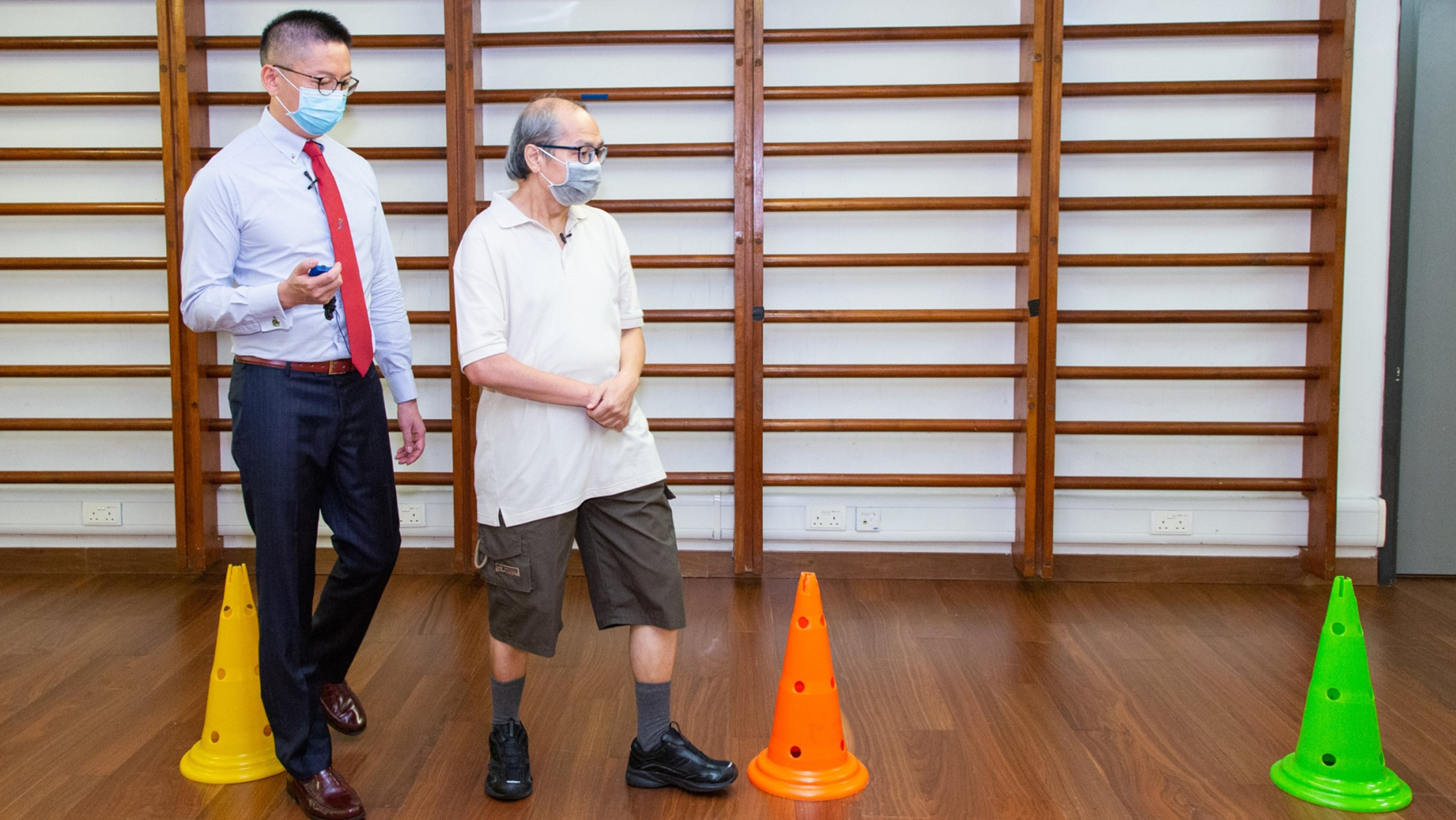
Study participants walked on flat ground and stepped over obstacles while completing cognitive tasks.
Crucially, the study revealed that this interference is highly task-dependent. Tasks demanding “internally driven” responses, such as serial subtraction, proved the most disruptive. These exercises place heavy demands on working memory and mental tracking, and it was during these that participants showed the most significant—and clinically meaningful—reductions in walking distance. Even more revealing, the combined effect of a task’s type and difficulty mattered more than either factor considered alone.
For Professor Pang, the implications are clear. “The results of our study underscore the importance of individualised assessments to better understand the dual-task challenges faced by post-stroke patients,” he explained, adding that meaningful evaluation must span cognitive tasks across different domains and difficulty levels to build a complete picture of how a patient moves while thinking.
Professor Tsang echoed this call for precision. Because strokes damage different brain regions governing distinct physical and cognitive functions, she noted, a one-size-fits-all approach simply cannot capture the varied deficits survivors face. “The precise identification of the specific functional deficits, followed by personalised training, is vital for achieving effective rehabilitation outcomes.”