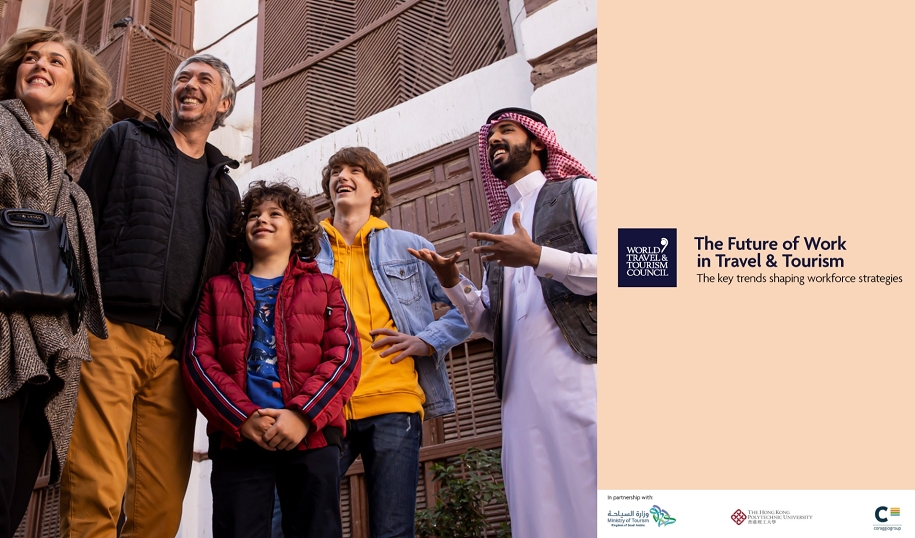
Already supporting 350 million jobs in 2024, the travel and tourism sector is set to create 91 million more by 2035. Yet a recent study released by the Research Centre for Digital Transformation of Tourism (RCdTT) and the World Travel & Tourism Council (WTTC) shows that the industry faces a growing talent challenge that could hinder the sector from reaching its full potential.
Led by Professor Haiyan Song, Associate Dean of the SHTM and Director of the RCDTT, and his team, comprising Professor Richard Qiu, SHTM Associate Professor and Professor Yitong Yu, SHTM Assistant Professor, along with Mr. Nejc Jus, Director of Research at WTTC, and co-authored with members from WTTC, this global survey of 349 industry stakeholders highlights urgent challenges in recruitment, retention, digital transformation and sustainability.
SHTM Dean Professor Kaye Chon emphasised the study's value: "This research provides actionable insights for businesses and policymakers to tackle workforce shortages and close critical skills gaps. We hope that the travel and tourism sector will find this report valuable in helping them remain competitive and sustainable".
Key Highlights from the Report
- A shifting workforce landscape
Post-pandemic changes, population ageing and new work models are reshaping traditional roles, while digitalisation and sustainability demand rapid adaptation.
- Skill gaps across all job levels
Managers need stronger critical and creative thinking; customer-facing roles require better leadership skills; and operational teams need greater reliability, flexibility and resilience. Lifelong learning is deemed essential.
- Major labour shortfall by 2035
The sector is projected to face a deficit of 43.1 million workers globally by 2035, with hospitality alone experiencing an 18% shortage. China, India and the EU are expected to face the largest such deficits.
The Path Forward: Eight Strategic Recommendations
The report calls for coordinated efforts to:
- enhance industry perception
- foster career progression
- ensure decent working conditions and inclusivity
- leverage technology to boost productivity
- facilitate recruitment flexibility
- improve the provision of Travel & Tourism qualifications
- strengthen collaboration and alignment between businesses and education providers
Professor Song remarked, "The findings of this study highlight an urgent need for collaborative action to address workforce shortages and skills gaps in travel and tourism. By providing data-driven insights and practical strategies, we aim to empower businesses, policymakers and educators to build a resilient, future-ready workforce that can sustain the sector's growth and competitiveness in the years ahead".
If you're interested in reading the full report, please download it from the WTTC website.
|
|