



Eligibility for PolyGate Agent Challenge
Only if you join the membership by 30 Oct!
Priority Access to Industry Engagement Ops
Gain Recognition for Your Contributions
Showcase Your Innovations
Present your ideas through dedicated sharing platforms
Be the First to Know
Receive early notifications of free training courses, hands-on workshops, and knowledge-sharing events.
Build Meaningful Connections
Join a university-wide network of students passionate about AI and innovation.
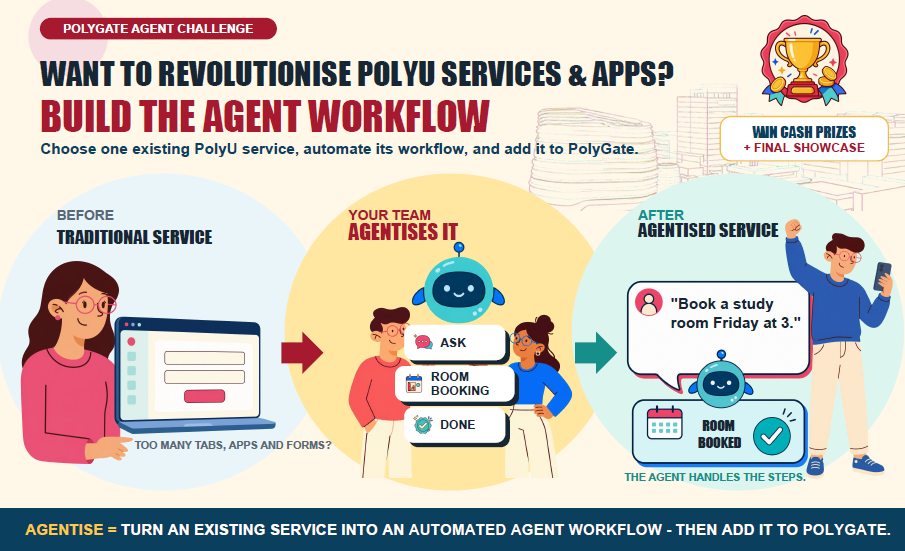
PolyU students currently navigate many separate websites, applications, and forms. Even routine tasks may require finding the right service, learning how to use its interface, and completing several manual steps. PolyGate aims to address this fragmentation by making existing web services accessible through AI agents and bringing these agents together in a unified gateway, giving students a single-entry point for campus services.
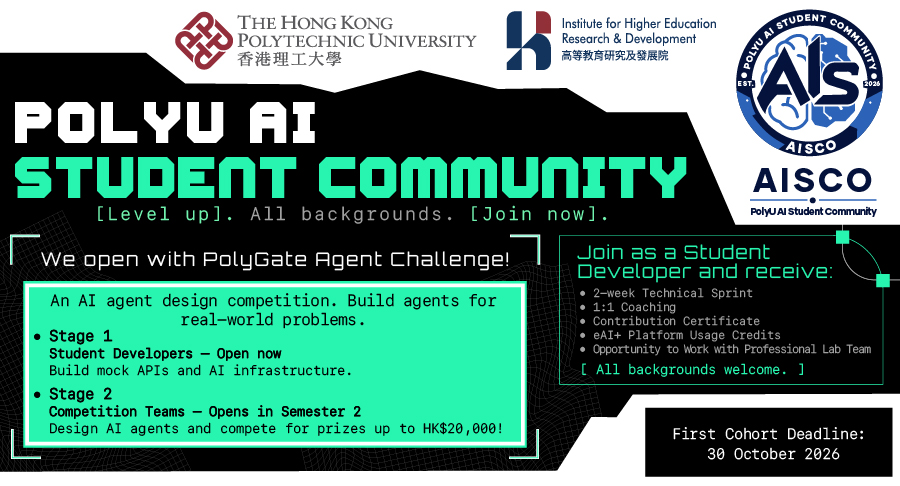
The PolyGate Agent Challenge is a two-stage student programme hosted by the Institute for Higher Education Research and Development (IHERD) and the Internet and Mobile Computing Lab (IMCL):
- Stage 1: Development (Opens now) — Selected students join as Student Developers to prepare the competition environment. They develop mock APIs and sandbox environments for approved services, then deploy the mock APIs and an approved LLM inference service on the isolated eAI+ platform.
- Stage 2: Competition (Opens in Semester 2) — Selected students join as Competition Team members to build agents for existing PolyU services. This process, known as agentisation, transforms traditional interfaces and manual processes into safe, automated agent workflows that could later be connected to PolyGate.
IHERD is now recruiting 8–12 Student Developers for Stage 1. This is a unique hands-on opportunity to gain supervised experience in AI agents, agent-native API design, service deployment, and operational practices on the University’s eAI+ platform.
You will work as part of a supervised technical team. Your work will directly enable Stage 2 Competition Teams to build agent workflows on a secure, isolated sandbox.
All backgrounds are welcome. We value diverse perspectives. While technical experience is helpful, students from any discipline who are motivated to learn and contribute can apply.
Stage 1: Student Developers (Opens Now)
To apply as a Student Developer, you should:
- Register as a member of the first cohort of PolyU AI Student Community by 30 October 2026 (Friday).
- Be a current PolyU undergraduate or postgraduate student (all Faculties and Schools).
- Be available for a two-week technical sprint, including attendance at 2 workshops and around 8 hours of self-paced development work.
- Commit to responsible conduct, transparent use of AI tools and adherence to approved service boundaries.
Note: To ensure fairness, Student Developers may join competing teams in Stage 2, but may only select topics involving services they did not work on during Stage 1.
Stage 2: Competition Teams (Register now. Eligible applicants will be contacted in Semester 2.)
To participate as a team member in the competition, you should:
- Register as a member of the first cohort of PolyU AI Student Community by 30 October 2026 (Friday).
- Be a current PolyU undergraduate or postgraduate student (all Faculties and Schools).
- Form or join a team of 3–5 students.
- Be available for the four-week competition period, including workshops, clinics, midpoint review and the final showcase in Semester 2.
- Be willing to work collaboratively, use only the approved sandbox APIs and tools, and follow the safe-use rules.
Note: All backgrounds are welcome for both stages. Cross-disciplinary teams are encouraged in Stage 2.
Stage 1: Student Developers
Student Developers receive formal recognition for their technical contributions and operational handover. This is designed to be meaningful for your CV, academic record, and future opportunities.
- Student Developer and Technical Contribution Certificate – Awarded to every Developer who completes the required onboarding, assigned deliverables, responsible-conduct obligations, and operational handover. The certificate formally recognises your accepted technical work.
- eAI+ Platform Usage Credits – Access to eAI+, a world-leading edge computing and AI platform featuring over 100 physical GPUs distributed worldwide and supporting hundreds of LLMs and general-purpose computing tasks.
-
Visibility and Networking – Work directly with IMCL. Strong contributions may be highlighted in programme evaluation and outcomes reporting.
Stage 2: Competition Teams
Participant teams (3–5 students) compete for cash prizes and certificates. Recommended prize structure (subject to final confirmation):
| Award | Amount |
|---|---|
| Champion | HK$20,000 |
| First Runner-up | HK$12,000 |
| Second Runner-up | HK$8,000 |
| Best Responsible Agent Design Award | HK$5,000 |
| Best User Impact and Experience Award | HK$5,000 |
- All finalists receive certificates and a place in the final showcase.
- Selected projects may be invited into a separately governed post-Challenge feasibility or incubation process for potential PolyGate integration.
Note: All prize amounts and the overall structure remain recommendations subject to final approval by the Steering Committee.
Stage 1: Student Developers
No technical background is required. Comprehensive training, coaching and support are provided throughout the development stage:
- 1:1 Coach assigned before Week 1. The coach provides at least one 30-minute individual check-in per week, reviews progress, identifies blockers, and helps prepare milestone evidence.
- Two technical workshops (approximately 2 hours each). Topics include Mock API design, OpenAPI, synthetic data, and testing; Docker, GHCR, eAI+ deployment, and LLM serving; Sandbox security, observability, incident response, and operational handover. Materials and recordings remain available.
- Technical clinics, code review, dependency and secret scanning guidance, and supervision during deployment.
- Clear completion requirements and milestone evidence expectations published before applications close.
Stage 2: Competition Teams
Once the readiness gate is passed, competition teams members receive structured learning support embedded in the competition stage:
-
Four core workshops (recorded and accompanied by short tutorials): What Is an Agent?; From Manual Steps to an Agent Workflow; Build Your Prototype with Coding Agents; Make It Useful, Safe, and Ready for Real Use.
-
Pre-work tutorial — A short recorded “Coding Agents for Beginners” tutorial provided before Workshop 1.
-
Weekly office hours and technical build clinics throughout the competition.
-
Service-owner and UX consultation clinics to help teams understand real workflows and user needs.
-
Starter kit, eAI+ support, and practical safe-use guidance so teams from all backgrounds can contribute.
Stage 1: Student Developers
As a Student Developer, you will work under supervision from IMCL to:
- Study five existing reference mock systems (including Room Booking, Student Locker, and others) and reproduce their deployment pattern.
- Help expand the catalogue by designing and developing up to seven additional mock APIs with synthetic data, OpenAPI contracts, tests, and documentation.
- Build and publish versioned Docker images; deploy the mock APIs and an approved LLM inference endpoint on the isolated eAI+ platform.
- Configure authentication, health checks, logging, quotas, and revocation procedures; run end-to-end, failure, and recovery tests.
- Document setup, deployment, monitoring, incident, and handover runbooks.
- Demonstrate that the deployed environment has no production route, production credentials, or live personal data.
Stage 2: Competition Teams
As a member of a Competition Team, you will:
- Choose one released service from the developer-vetted catalogue and understand its users, current steps, exceptions, and success criteria.
- Redesign the service as an agent workflow, identifying what the model may decide and what must remain deterministic or require human confirmation.
- Build the workflow using coding agents and other approved tools, calling only the reviewed eAI+ LLM and mock API endpoints.
- Validate the working prototype by demonstrating the before-and-after experience, handling normal and failure cases, and providing test evidence.
- Prepare the required deliverables, including an Agentisation Brief, Agent Workflow Blueprint, working prototype, demonstration, and known-limitations note.
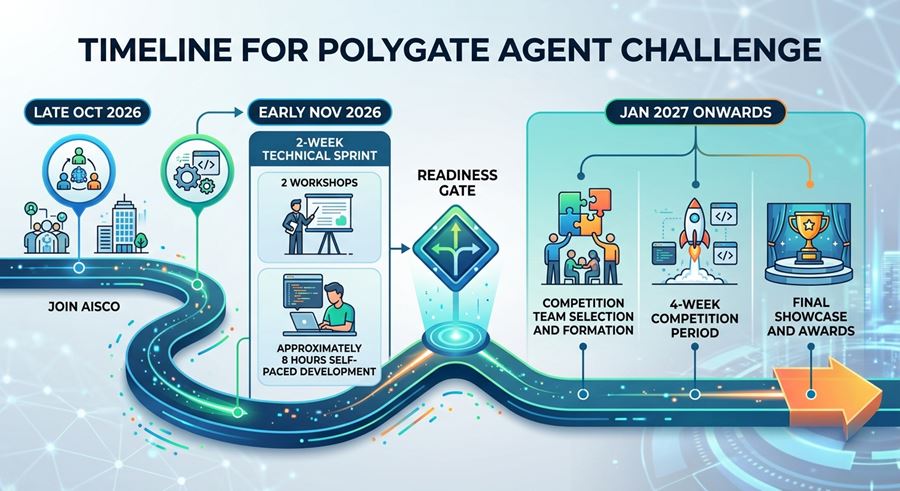
Stage 1: Development (Nov 2026)
| Time | Activities: |
|---|---|
| Late Oct – Early Nov |
Application & Selection
|
| Early Nov 2-Week Technical Sprint (2 workshops + approximately 8 hours of self-paced development) |
Workshop 1: (4 Nov, 10:00-12:00, Venue TBC)
|
Workshop 2: 11 Nov 2026 (10:00-12:00, Venue TBC)
|
Stage 2: Competition (Later in Semester 2)
| Proposed Time | Proposed Activities: |
|---|---|
| Start of Semester 2, 2027 | Competition Team Formation & Selection |
| 4-Week Competition Period | Choose a challenge topic and target task. Attend Workshop 1 and produce an Agent Concept Brief. |
| Design the agent workflow. Attend Workshop 2 and develop an Agent Workflow Blueprint. | |
| Build and test the prototype. Attend Workshop 3 and participate in the midpoint review and coaching clinics. | |
| Refine the solution, prepare the final showcase, attend Workshop 4, and present the project for judging and awards. |
Exact dates and workshop schedules of Stage 2 will be communicated in Semester 2.
The Stage 2 judging panel is expected to include representation from:
- IHERD management
- IMCL / Lab leadership
This senior involvement ensures that both the technical foundation you help build and the later student projects are evaluated against University standards for usefulness, responsibility, and potential real-world impact.
Enquiries
PolyU AI Student Community
