
Envisioning Islands - Public Lecture Series on Maritime History and Literature - From Maritime Trade to Land Ownership: The Chinese of Pampanga in the 17th century

-
Date
18 Sep 2026
-
Organiser
Co-organised by the Research Centre for Chinese History and Culture, The Hong Kong Polytechnic University; the University of Macau; Institute of Chinese Studies, The Chinese University of Hong Kong; the French School of Asian Studies and the Department of Chinese, Lingnan University
-
Time
14:30 - 16:00
-
Venue
Room 3118, Humanities and Social Sciences Building (E21A), the University of Macau
Enquiry
Ms Carmen LAW 34008979 rcchc@polyu.edu.hk
Remarks
This talk will be delivered in English
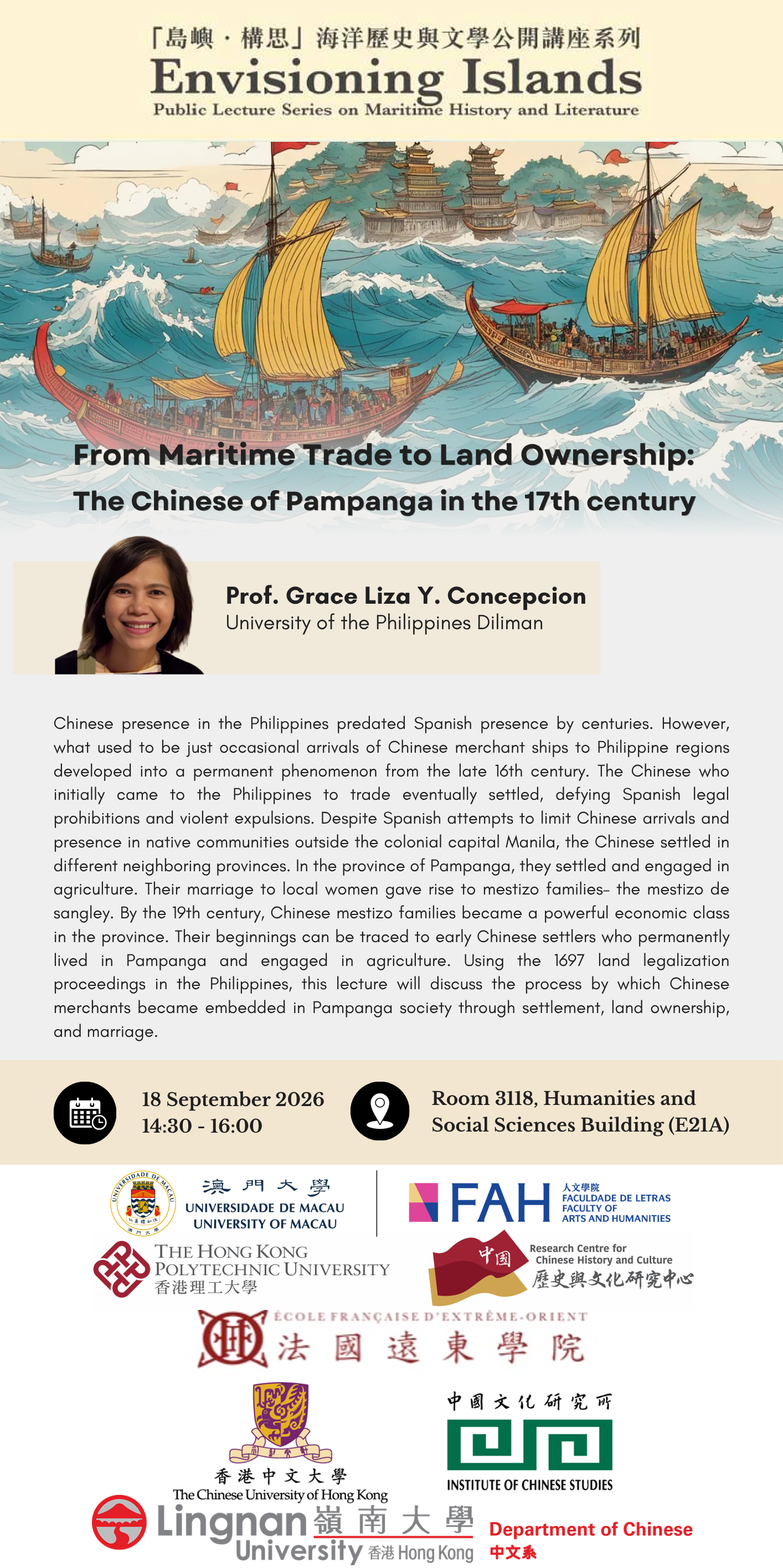
Summary
Chinese presence in the Philippines predated Spanish presence by centuries. However, what used to be just occasional arrivals of Chinese merchant ships to Philippine regions developed into a permanent phenomenon from the late 16th century. The Chinese who initially came to the Philippines to trade eventually settled, defying Spanish legal prohibitions and violent expulsions. Despite Spanish attempts to limit Chinese arrivals and presence in native communities outside the colonial capital Manila, the Chinese settled in different neighboring provinces. In the province of Pampanga, they settled and engaged in agriculture. Their marriage to local women gave rise to mestizo families- the mestizo de sangley. By the 19th century, Chinese mestizo families became a powerful economic class in the province. Their beginnings can be traced to early Chinese settlers who permanently lived in Pampanga and engaged in agriculture. Using the 1697 land legalization proceedings in the Philippines, this lecture will discuss the process by which Chinese merchants became embedded in Pampanga society through settlement, land ownership, and marriage.
