




A Major October Highlight of the 3rd PolyU Chinese Culture Festival: ICH "Yao Embroidery" Workshop Concludes to Wide Acclaim
To promote traditional Chinese culture and foster a profound sense of national pride among students, the thematic October event of the 3rd PolyU Chinese Culture Festival—the “Hakka Heritage in the Bay Area: Shaping a Shared Future” – Greater Bay Area Hakka Cultural Joint Showcase—has concluded with resounding success. Inaugurated on National Day (1 October 2026) and running through 16 October, the two-week event drew more than 2,500 PolyU staff, students, alumni, and members of the public through an immersive thematic exhibition, an original large-scale dance drama, an academic symposium, and hands-on intangible cultural heritage (ICH) workshops.
Among the rich array of festival highlights, the HKPM-PolyU Joint Chinese Textile Centre (JCTC) placed a special spotlight on the National ICH "Yao Embroidery" experiential workshops. Utilizing vibrant five-color silk threads to bridge ancient tradition and contemporary life, the workshops drew nearly 200 participants into direct engagement with living ethnic textile heritage. Throughout the sessions, JCTC also distributed commemorative JCTC booklets to participants, actively championing its overarching mission to continuously promote Chinese textile arts and craftsmanship to the wider community.
Living History on Fabric: The Legacy of Yao Embroidery
The history of Yao embroidery stretches back millennia. Historical records dating back to the Han dynasty, including the Book of the Later Han, document early southern ancestors crafting garments from tree bark and plant dyes, noting their distinctive fondness for "five-colored attire." Embroidered skirts were already widespread by the Sui and Tang dynasties, reaching their aesthetic peak during the late Ming and early Qing eras. In 2011, Yao Embroidery was officially inscribed onto the National List of ICH.
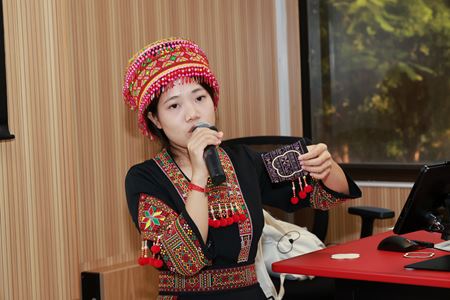
The Yao speaker introduces the traditional colors and patterns of Ruyuan Yao embroidery.
|
The workshop highlighted the distinct embroidery of Ruyuan County, Guangdong—the globally recognized ancestral homeland of the "Guoshan Yao" (Mountain-crossing Yao). Historically leading a nomadic slash-and-burn life across rugged mountain ranges ("on this mountain this year, across another ridge the next"), the Yao people, without an indigenous written script, transformed their needles and threads into an "unwritten living history book." Embroidered primarily on black, blue, or white base cloth with red, green, yellow, black, and white threads, Ruyuan Yao embroidery features a remarkable technique: reverse-side embroidery. Working entirely from the back without drawn sketches or pre-printed stencils, artisans rely on memory and counted fabric grids to produce perfectly symmetrical, geometric patterns on the front face.
|
From Ancient Totems to Modern Lifestyle: Crafting Yao Embroidery Cultural Creations
Led by master artisans, the workshop opened with an exploration of authentic Guoshan Yao ceremonial attire and creative cultural products. Instructors guided attendees through the sacred geometric motifs: the Eight-pointed Flower (Sun Pattern) symbolizing warmth, light, and ethnic unity; the Seal of King Pan honoring ancestral totems for peace and auspiciousness; the Deer and Dog Patterns providing protection from misfortune; and the Fish Patterns signifying abundance and prosperity.
Merging ancient craft with everyday life, participants engaged in a hands-on session creating their own "Yao Embroidery Refrigerator Magnets." Guided step-by-step, attendees practiced edge-yarn finishing, geometric pattern placement, and pearl embellishments, bringing traditional minority embroidery into modern domestic design. The sessions concluded with participants proudly showcasing their handcrafted pieces in a commemorative group photo.
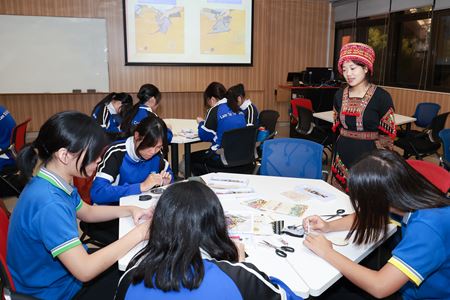 Amid an enthusiastic atmosphere in Session 2 (Lam Tai Fai College Exclusive Session), students craft creative "Yao Embroidery Refrigerator Magnets" under the step-by-step guidance of instructors. |

As the workshop comes to a successful close, attendees gather for commemorative group photos, proudly holding up their ingeniously designed Yao embroidery creations. |
JCTC Booklets Inspire Ongoing Engagement with Textile Heritage
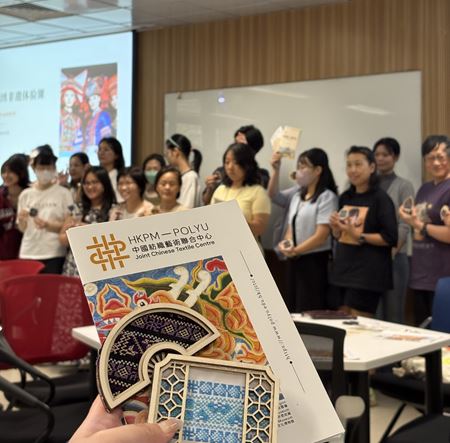 |
As a dedicated champion of traditional Chinese weaving and embroidery heritage, the Joint Chinese Textile Centre (JCTC) distributed specially booklets to all participants across the sessions. This initiative aimed to call for continuous public appreciation of traditional Chinese textile culture—from its rich historical evolution to its modern creative preservation—while encouraging participants to stay informed and engaged with upcoming cultural activities of a similar nature. JCTC noted that, through the tactile experience of the Yao embroidery workshop coupled with the informative booklets, the Centre aspires to transcend the boundaries of a single workshop session. By embedding traditional Chinese textile and dress culture deeply into the hearts of the public and the younger generation, JCTC hopes to inspire more youth to proactively explore, appreciate, and safeguard traditional textile arts. |
The successful conclusion of the ICH workshops at the 3rd PolyU Chinese Culture Festival not only established a vibrant bridge on campus between ancient ethnic craftsmanship and modern creative design, but also injected enduring, youthful vitality into the ongoing transmission of fine Chinese culture.
