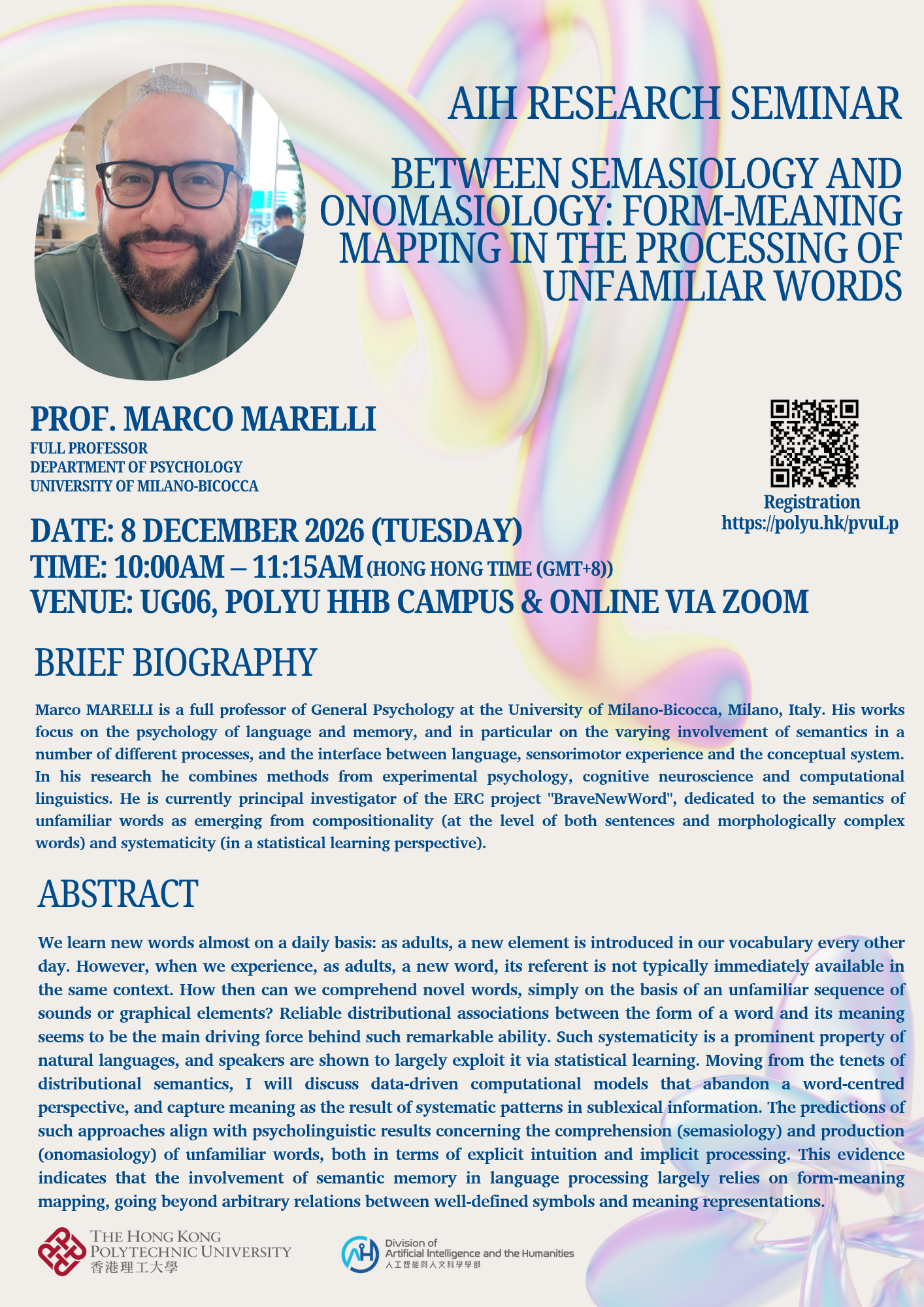
AIH Research Seminar: Between Semasiology and Onomasiology: Form-meaning Mapping in the Processing of Unfamiliar Words
AIH Research Seminar

-
Date
08 Dec 2026
-
Organiser
Division of Artificial Intelligence and the Humanities
-
Time
10:00 - 11:15
-
Venue
UG06, PolyU HHB Campus & Online via Zoom Map
Summary
Abstract
We learn new words almost on a daily basis: as adults, a new element is introduced in our vocabulary every other day. However, when we experience, as adults, a new word, its referent is not typically immediately available in the same context. How then can we comprehend novel words, simply on the basis of an unfamiliar sequence of sounds or graphical elements? Reliable distributional associations between the form of a word and its meaning seems to be the main driving force behind such remarkable ability. Such systematicity is a prominent property of natural languages, and speakers are shown to largely exploit it via statistical learning. Moving from the tenets of distributional semantics, I will discuss data-driven computational models that abandon a word-centred perspective, and capture meaning as the result of systematic patterns in sublexical information. The predictions of such approaches align with psycholinguistic results concerning the comprehension (semasiology) and production (onomasiology) of unfamiliar words, both in terms of explicit intuition and implicit processing. This evidence indicates that the involvement of semantic memory in language processing largely relies on form-meaning mapping, going beyond arbitrary relations between well-defined symbols and meaning representations.
Brief Biography
Marco MARELLI is a full professor of General Psychology at the University of Milano-Bicocca, Milano, Italy. His works focus on the psychology of language and memory, and in particular on the varying involvement of semantics in a number of different processes, and the interface between language, sensorimotor experience and the conceptual system. In his research he combines methods from experimental psychology, cognitive neuroscience and computational linguistics. He is currently principal investigator of the ERC project "BraveNewWord", dedicated to the semantics of unfamiliar words as emerging from compositionality (at the level of both sentences and morphologically complex words) and systematicity (in a statistical learning perspective).