
Research Interest: Air transport network; network disruption and recovery; network resilience
Education
B.Eng, Safety Engineering, Central South University, 2012.09-2016.06
M.Eng, Aerospace System Safety and Reliability Engineering, Beihang University, 2016.09-2019.01
Ph.D, Aviation Engineering, The Hong Kong Polytechnic University, 2022.09-present
Signature research outcomes

Core Research
Research 1: Spatial temporal modelling of air traffic network evolution and resilience enhancement in response to the dynamic coupling of propagation outbreaks.
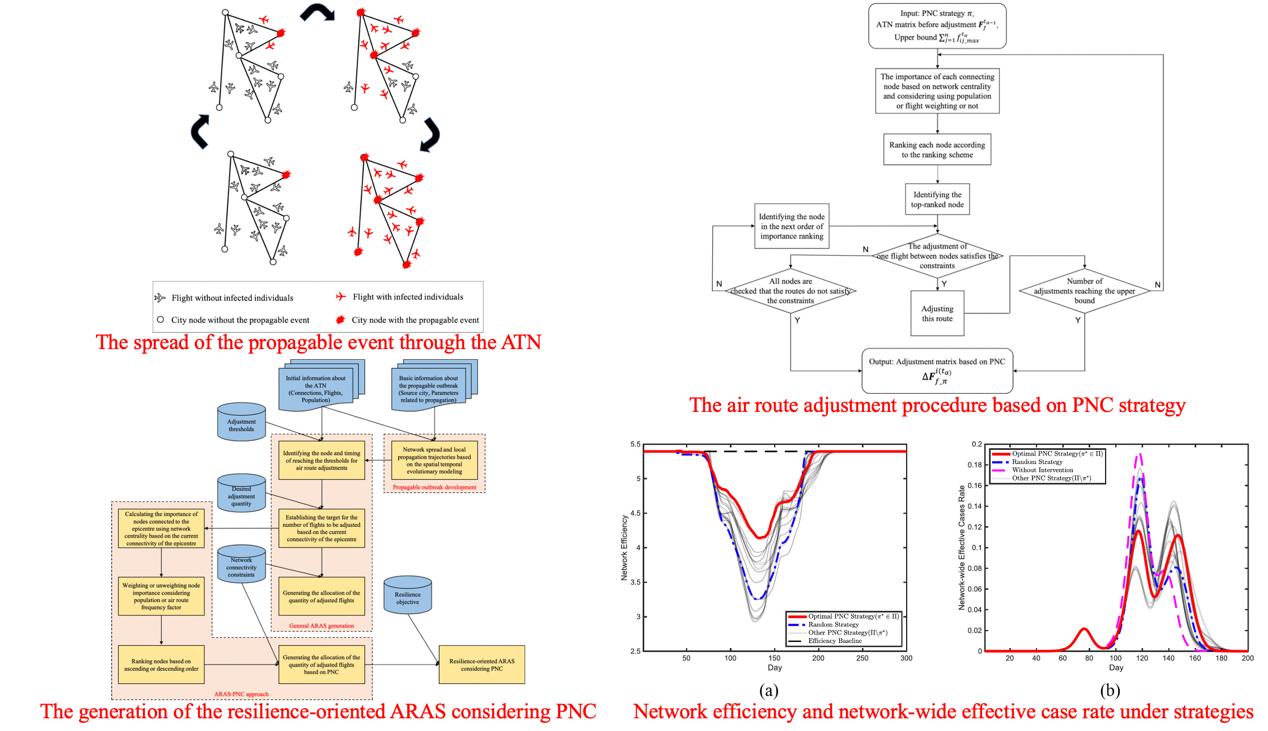
Air traffic network evolution during propagation outbreaks was modelled using a spatial temporal coupling framework that links propagable outbreak diffusion and aviation mobility dynamics. Network resilience across the full event cycle was evaluated, and air route adjustment strategies prioritising network centrality were developed to assess their effects on outbreak-risk mitigation and recovery of air transport efficiency.
Main contributions of Research 1:
1) Proposed a spatial temporal coupling framework linking propagable outbreak evolution with air traffic network structure, capturing how propagable event progression and aviation mobility jointly shape the timing, sequence, and intensity of network disruptions.
2) Extended air traffic network resilience assessment from static connectivity loss or post-event comparison to a full-cycle evaluation covering outbreak escalation, restriction, and recovery phases.
3) Designed and evaluated a prioritised-network-centrality-based air route adjustment scheme, demonstrating its ability to balance outbreak-risk mitigation and transport efficiency, particularly by controlling imported cases during the early outbreak stage.
Research 2: Resilient recovery of the air traffic network through slot reallocation and weather-aware capacity estimation after network-level large-scale disruptions.
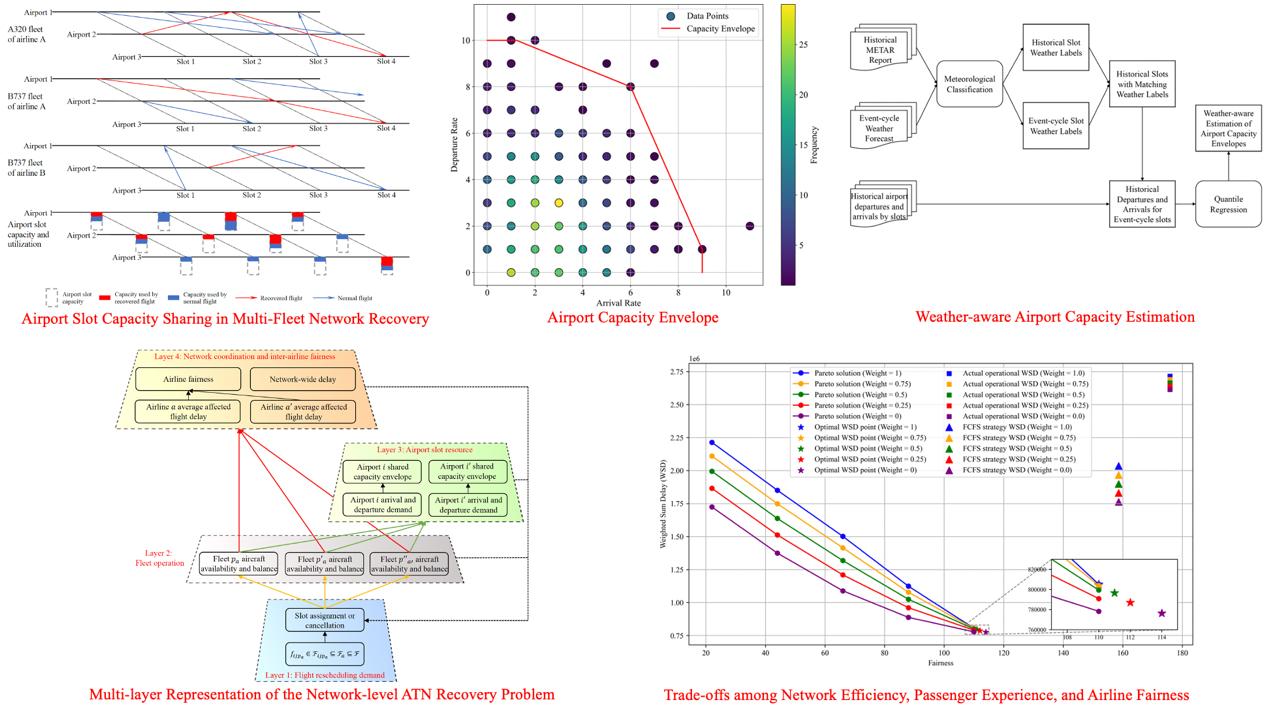
A resilient recovery framework was developed for air traffic networks following large-scale network-level disruptions, with emergency slot reallocation as the primary recovery mechanism. A multi-layer model was built to capture resource conflicts among flights, fleets, airlines, and airports, while integrating weather-aware airport capacity estimation based on quantile regression. A case study of the U.S. domestic air traffic network during the FAA system outage on January 11, 2023 was used to evaluate trade-offs among network efficiency, passenger experience, and airline fairness.
Main contributions of Research 2:
1) Proposed a multi-layer air traffic network recovery framework that decomposes network-level disruption impacts into coupled flight-, fleet-, airline-, and airport-level recovery decisions.
2) Developed a slot reallocation optimisation model that jointly considers airport capacity, fleet availability, schedule continuity, passenger-weighted delay, and inter-airline fairness.
3) Integrated data-driven, weather-aware airport capacity estimation into network recovery modelling, enabling more realistic capacity constraints.
Key Publications
Journal Paper
[1] Zhu, Y., & Ng, K. K. (2025). Spatial temporal modelling of air traffic network evolution and resilience enhancement in response to the dynamic coupling of propagation outbreaks. Journal of Transport Geography, 123, 104116.
[2] Zhu, Y., Ng, K. K., Li, A., Hansen, M., & Sun, X. (2027). Resilient recovery of the air traffic network through slot reallocation and weather-aware capacity estimation after network-level large-scale disruptions. Transportation Research Part A: Policy and Practice. (Under Revision)
Conference Paper
[1] Zhu, Y. & Ng, K. K. H. (2023, Jul). Resilience enhancement strategy of airports in response to disruptions aided by high-speed rail. In The 26th ATRS World Conference. Kobe, Japan.