
Research Interest: Air Transportation | Air Traffic Control | Aviation Meteorology | Deep Learning | Reinforcement Learning
Education
B.Eng., Software Engineering, Yanshan University, 2014.09-2018.06
M.Sc., Computer Engineering, University of Illinois at Chicago, 2017.08-2019.06
Ph.D, Aviation Engineering, The Hong Kong Polytechnic University, 2022.01-2025.12
International Visit
International Visit Student, The University of New South Wales, 2024.09-2024.11
Signature research outcomes


Core Research
Research 1: Spatiotemporal Image-Based Flight Trajectory Clustering Model with Deep Convolutional Autoencoder Network.
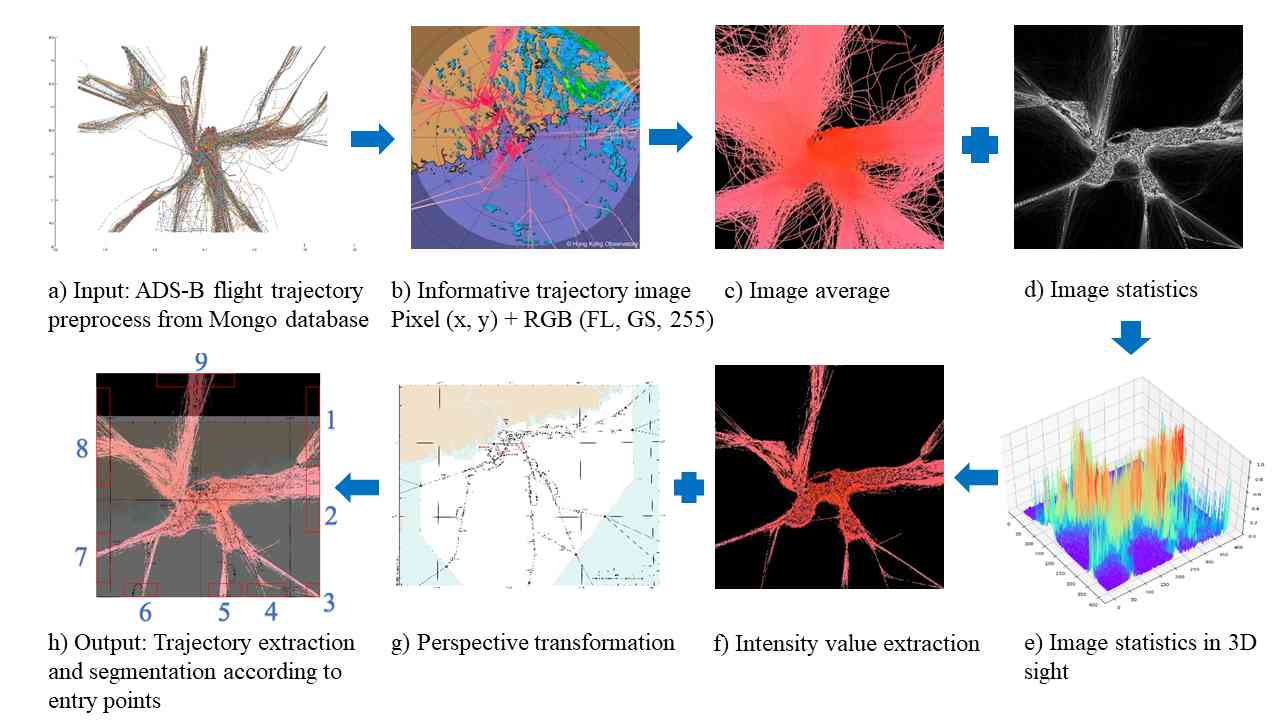
This research proposes a novel flight trajectory clustering approach that transforms spatiotemporal trajectory data into image representations and employs a deep convolutional autoencoder network to extract latent spatial features. The model enables unsupervised learning of trajectory patterns without relying on predefined similarity metrics, and is validated using real-world flight data to demonstrate its effectiveness in identifying common route structures and anomalous behaviors.
Main contributions of Research 1:
1) Proposes an image-based transformation framework that converts spatiotemporal flight trajectories into 2D representations compatible with convolutional neural networks.
2) Develops a deep convolutional autoencoder architecture for unsupervised trajectory clustering.
3) Demonstrates superior clustering performance on real-world flight data compared to conventional trajectory similarity-based methods.
Research 2: A Spatiotemporal Flight Trajectory Prediction and Online Learning Framework Based on Integrated Transformer-Bidirectional Gated Recurrent Unit.
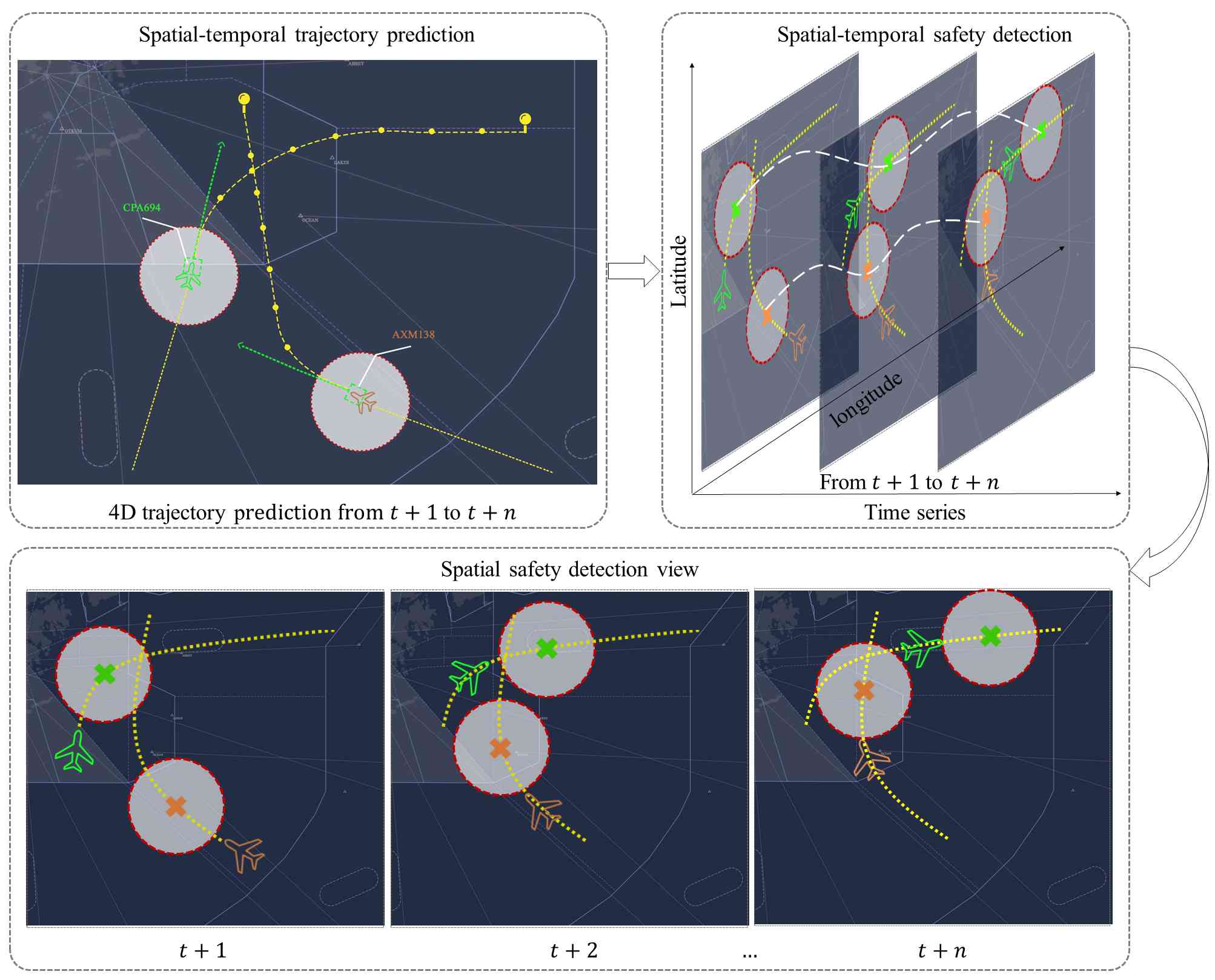
This paper presents an online learning framework that integrates Transformer and Bidirectional Gated Recurrent Unit (BiGRU) architectures for spatiotemporal flight trajectory prediction. The Transformer module captures long-range dependencies in sequential trajectory data, while the BiGRU component models bidirectional temporal dynamics. An online learning mechanism is incorporated to enable continuous model adaptation to real-time data streams, addressing the challenge of dynamic airspace environments.
Main contributions of Research 2:
1) Proposes an integrated Transformer-BiGRU architecture that captures long-range dependencies and bidirectional temporal patterns in flight trajectories.
2) Incorporates an online learning framework that enables real-time model updates, improving adaptability to dynamic operational conditions.
3) Enables controllers to preemptively mitigate collision risks through early hazard detection, transforming reactive responses into proactive avoidance strategies.
Research 3: Spatio-temporal Weather and Airspace Graph Network (SWAG-Net) for Trajectory-Based Estimated Time of Arrival Prediction.
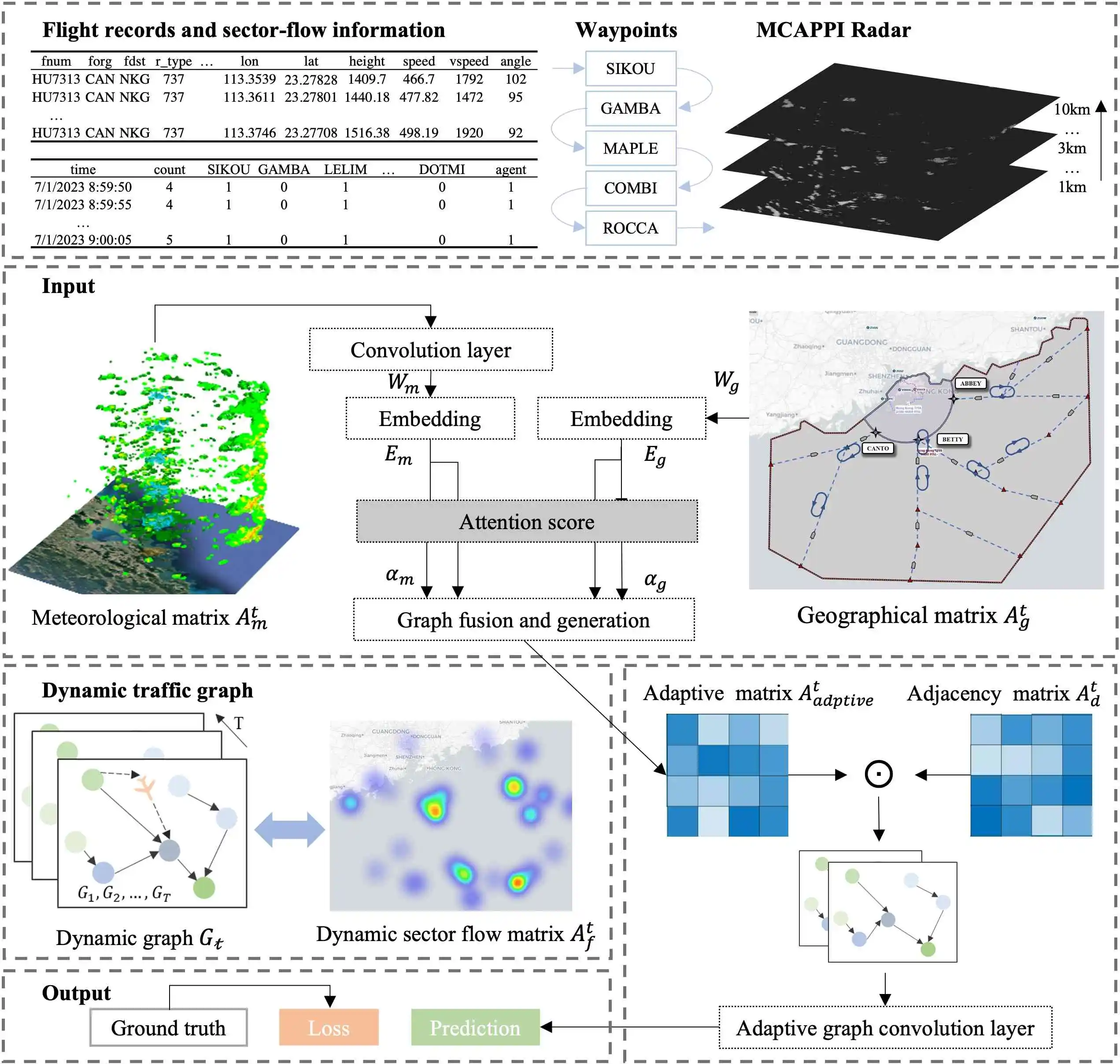
This paper proposes a novel Spatio-temporal Weather and Airspace Graph Network (SWAG-Net) to predict flight Estimated Time of Arrival (ETA) under various operational and meteorological conditions. The model embeds arrival route structures and spatiotemporal patterns into a graph neural network framework, integrating real-time meteorological impacts to enhance prediction accuracy. Additionally, it provides insights into the impact of convective weather on flight duration within the airspace.
Main contributions of Research 3:
1) Designs a graph neural network architecture that captures airspace route structures and spatiotemporal weather dynamics for ETA prediction.
2) Integrates real-time meteorological data as a core component of the prediction framework.
3) Enhancement performance over baseline models through spatio-temporal encoding and empirical analysis of the impact of convective weather on ETA.
Key Publications
Journal Paper
[1] Liu, Y., Ng, K. K. *, Chu, N., Kwong Hon, K., & Zhang, X. (2023). Spatiotemporal Image-Based Flight Trajectory Clustering Model with Deep Convolutional Autoencoder Network. Journal of Aerospace Information Systems, 1-13.
[2] Liu, Y., Chu, N., Ng, K. K. *, Ribeiro, N. A., Zhu, C., Chan, P. W., & Leung, C. Y. (2026). Spatio-temporal weather and airspace graph network (SWAG-Net) for trajectory-based estimated time of arrival prediction. Transportation Research Part E: Logistics and Transportation Review, 213, 104966.
[3] Liu, Y., Ng, K. H., Wu, C. L., Chu, N., Zhang, X., Hon, K. K., & Leung, C. Y. Y. (2025). A Spatiotemporal Flight Trajectory Prediction and Online Learning Framework Based on Integrated Transformer-Bidirectional Gated Recurrent Unit. IEEE Transactions on Intelligent Transportation Systems.