
Research Interest: Human factors and ergonomics in transportation, Collaborative human-machine interface design, Human-AI teaming
Education
B.Eng, Industrial Design, University of Jinan, 2015.09-2019.06
M.Eng, Industrial Design Engineering, Shandong University, 2019.09-2022.06
Ph.D, Aviation Engineering, The Hong Kong Polytechnic University, 2022.09-2026.03
Employment
Project Associate, The Hong Kong Polytechnic University, 2025.09-2026.03
Postdoc research fellow, The Hong Kong Polytechnic University, 2026.04-Now
Core Research
Research 1: From Unrecognised to Incapacitating: Neuroergonomic Differentiation of Spatial Disorientation Typologies Induced by Visual Illusions for Pilot Cognitive Training and Cockpit Design.
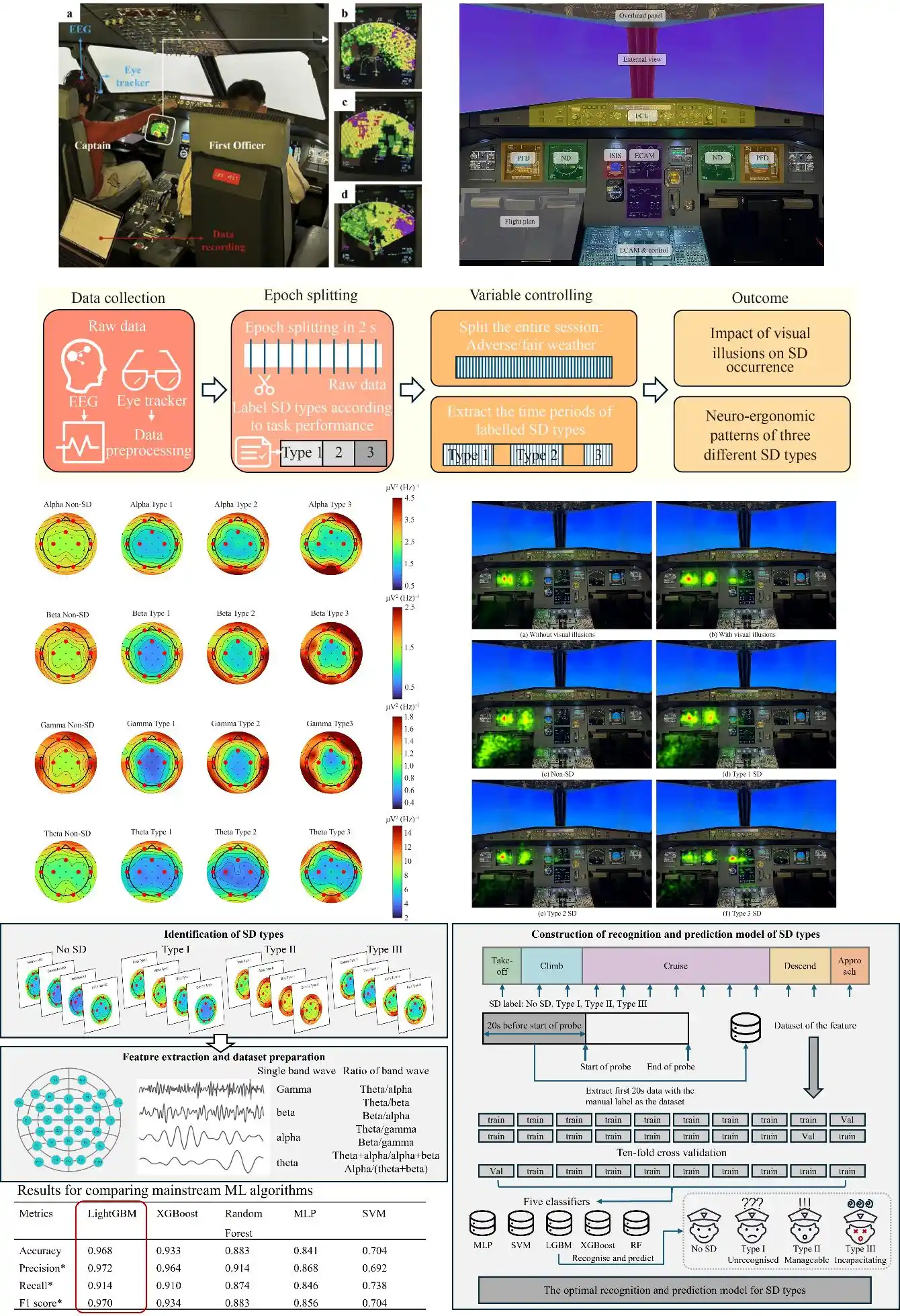
Spatial Disorientation (SD) causes 15 %–22 % of general aviation fatalities, rising to 72 % with conflicting visual references. Current detection methods fail to distinguish the three SD types: Type 1 (unrecognized), Type 2 (recognized), and Type 3 (incapacitating), nor the effects of visual illusions. This study presents a neuro-ergonomic framework combining 32-channel Electroencephalogram (EEG) and eye-tracking to identify subtype-specific signatures during visual illusions. Sixteen cadet pilots completed simulated flights under adverse weather and inconsistent instrument displays to induce the three SD types. A customized SD-Probe scale was used to label dynamic SD types during flight. The results showed hierarchical neurophysiological changes: pilots without SD had balanced brain activity; Type 1 showed the lowest neural engagement; activation increased from Type 1 to Type 3, with narrowing visual scanning. Types 2 and 3 exhibited enhanced Beta and Gamma activity in prefrontal and occipital regions, reflecting increased cognitive processing during spatial conflicts. Conflicting visual illusions heightened arousal in peripheral brain areas, disrupting spatial awareness and flight parameter cross-checking. This pioneering study monitors SD occurrence and transitions triggered by visual illusions from a neuro-ergonomics perspective, offering insights into targeted pilot training and multimodal SD detection methods.
Main contributions of Research 1:
1) Compared to the no SD state, different SD types showed varied neuro-ergonomic patterns related to cognitive demands and processing abilities.
2) Developing reliable EEG-based models that accurately differentiate four fine-grained SD types, with LightGBM achieving 96.8% accuracy.
3) Integrating real-time neuro-ergonomic monitoring systems in the cockpit to detect early signs of SD and guide the pilot support systems' design.
Research 2: A Hybrid Proactive Framework for Spatial Disorientation Prediction and Attention-Guided Intervention to Enhance Cognitive Resilience in Pilot-Aircraft Systems.
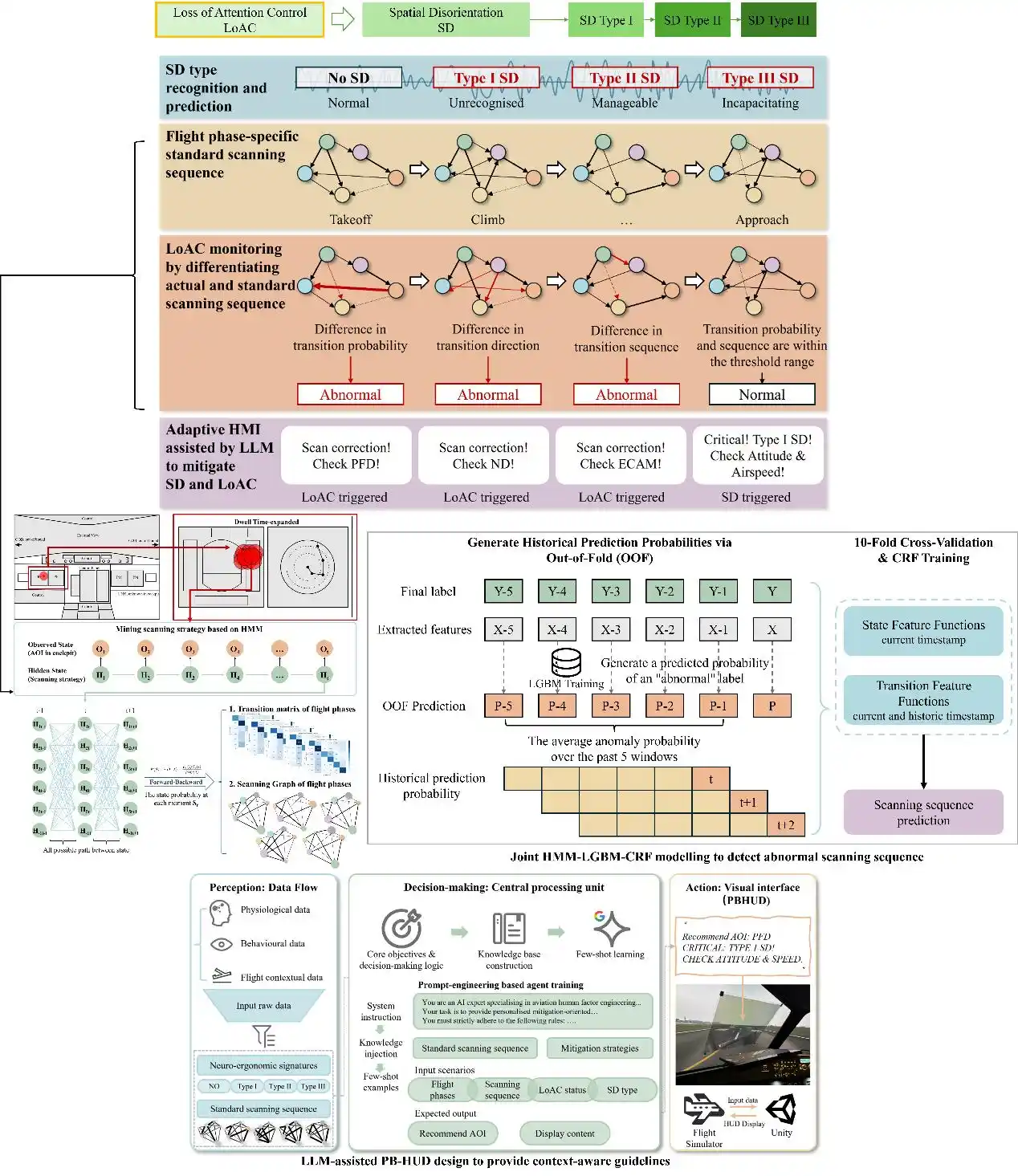
Pilot cognitive resilience demands cockpit systems capable of sensing and response to cognitive degradation. Spatial Disorientation (SD) and Loss of Attentional Control (LoAC) are critical human reliability challenges. This study introduces the Adaptive Attention-Awareness Pilot-Aircraft Interaction (3A-PAI) system, a multimodal framework for monitoring, predicting, and mitigating LoAC-induced SD via an adaptive projection-based head-up display (PB-HUD) assisted by Large Language Model (LLM). Hidden Markov Models (HMMs) and a hybrid Conditional Random Field (CRF)-LightGBM approach modelled normative scanning sequences to predict LoAC-related anomalies. These multimodal recognition outputs are mapped to a structured knowledge base that supports few-shot, context-grounded recommendation generation by an LLM. As the adaptive intervention layer of 3A-PAI, a PB-HUD prototype illustrates how context-sensitive visual cues could be generated to redirect pilot attention during emerging SD events. Overall, the framework establishes a reliability-oriented pathway from cognitive-state recognition and prediction to adaptive intervention, shifting from retrospective human error analysis to model-based cognitive support for safety-critical operations.
Main contributions of Research 2:
1) We then constructed phase-specific visual scanning baselines using HMMs and introduced a hybrid HMM–CRF–LightGBM framework with sliding windows, enabling sensitive detection of early attentional degradation.
2) We developed the LLM-assisted PB-HUD, which delivers context-adaptive visual guidance and forms a proactive closed-loop system that shifts cockpit assistance toward early recognition and timely intervention.
3) Unifies neuro-ergonomic sensing, behavioural prediction, and adaptive HMI within one integrated architecture.
4) Proposes a resilience-centred model of next-generation pilot–aircraft interaction based on HUD.
Research 3: Exploring the Human-Centric Interaction Paradigm: Augmented Reality-Assisted Head-Up Display Design for Collaborative Human-Machine Interface in Cockpit.
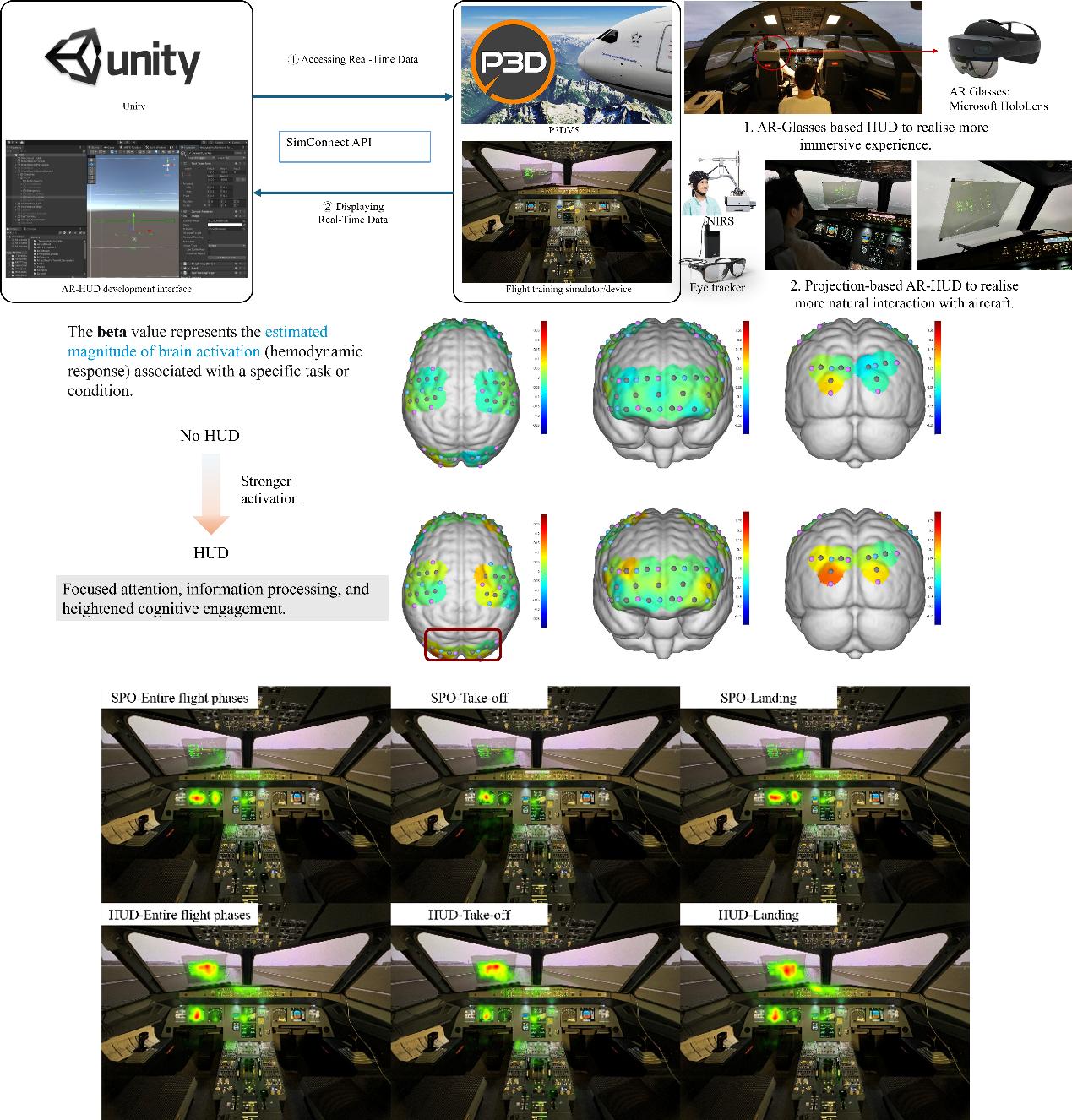
SPO can only realise when reduced crew operations initiative is proven to be safe and airworthy. Public concerns pilot mental workload and potentially low situational awareness (SA) when handling overwhelmed multi-source information from the HMI in a cockpit, leading to degraded skills and flying performance. Advanced head up display (HUD) design, an integrated transparent display, can assist pilots in maintaining their optimal performance when SPO exercised. In this study, we are interested to design a SPO-favoured cockpit design with HUD and investigate the potential of integrating augmented reality (AR) and HUD in SPO in flight operations. Two prototypes of Augmented Reality-HUD (AR-HUD) were conducted to assess the effectiveness of AR-HUD on SA and workload in DPO, SPO, and SPO with AR-HUD scenarios. The Situation Awareness Present Assessment Method (SPAM) and a self-rated workload scale were used to evaluate SA and workload levels. Eye-tracking data was also collected to analyse behavioural performance. Results indicated that the AR-HUD scenario achieved optimal workload and SA levels and demonstrated superior performance in handling emergencies. Eye-tracking data revealed that AR-HUD facilitated a more equitable distribution of gaze between instruments and external view. In conclusion, the integration of AR in cockpit design introduces a human-centric interaction paradigm, contributing to aviation safety, SPO implementation and adaptive HMI design.
Main contributions of Research 3:
1) A multidimensional assessment approach was proposed to examine the effect of the AR-HUD for pilots’ Situational awareness (SA), workload level and attention allocation.
2) The AR-HUD helps maintain better SA and workload levels while reducing the number of gaze points for looking down at individual instruments.
3) Implementing AR in the CHMI of cockpit design introduces a human-centric pilot-support system that will contribute to aviation safety and allows the implementation of SPO to provide a feasible solution.
Research 4: Cognitive Buffer Under Dual Load: How Habitual Traffic Environmental Conflict and Sensory Distraction Deplete Working Memory in Driving.
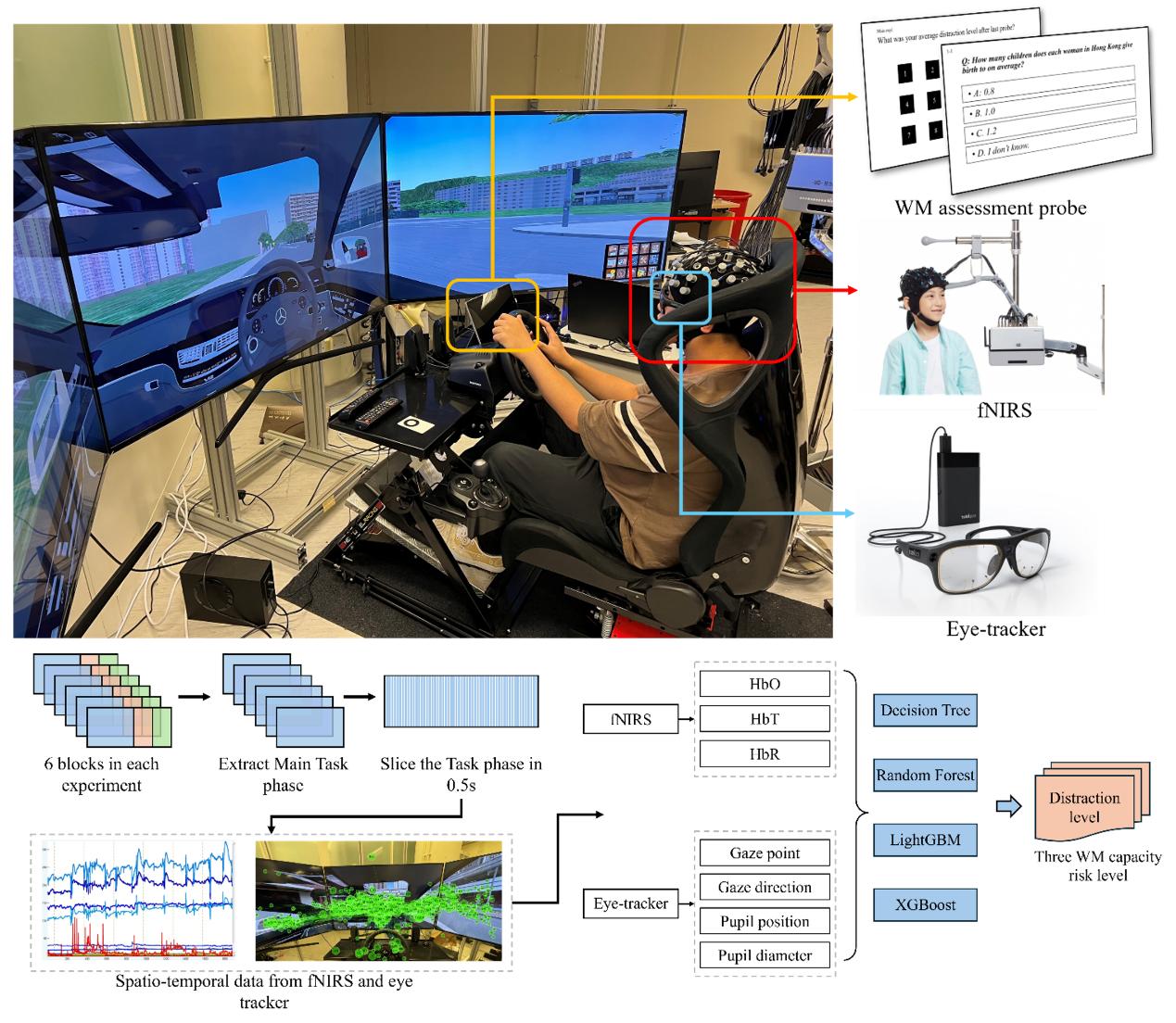
Working memory (WM) serves as a critical safety buffer against cumulative cognitive load, yet the interaction between implicit load and explicit tasks remains under-researched. This study investigates how this buffer is compromised by two distinct load categories: implicit load, operationalised as Habitual Traffic Environmental Conflict (HTEC) (Left-Hand Traffic, LHT vs. Right-Hand Traffic, RHT), and explicit load, operationalised as sensory distractions (visual/auditory). Thirty drivers completed simulated driving in an RHT environment. A multimodal approach (subjective assessment, fNIRS, and eye-tracking) was employed to characterize neuro-behavioural signatures of WM capacity. Results indicate that implicit HTEC pre-emptively depletes WM reserves, evidenced by sustained parietal-occipital activation. Visual distractions induced greater cortical activation than auditory ones. Linear mixed-effects modelling revealed significant three-way interactions (HTEC × distraction × WM capacity), indicating nonlinear resource competition. Notably, as WM risk increased, prefrontal activity exhibited an initial rise followed by a collapse, signalling executive control failure. Furthermore, an XGBoost model classified three WM risk levels with 95.4% accuracy, validating the predictive power of fused neuro-behavioural features. These findings provide robust evidence for WM’s buffering role, supporting the design of proactive, adaptive driver-assistance systems and safety policies to mitigate cognitive resource depletion and reduce traffic fatalities.
Main contributions of Research 4:
1) Analyzing complex triple-interaction effect among HTEC, distraction type, and WM capacity risk. This interaction definitively proves that WM depletion is a cumulative process, not simply an additive one.
2) Integrating machine learning models for WM capacity risk classification based on neuro-ergonomic patterns present a promising avenue for future applications. LightGBM and XGBoost achieved satisfactory accuracy at 94.27% and 95.42% for classifying three levels of WM capacity risk.
3) The obtained neuro-ergonomic models emphasise the potential and necessity for developing tailored interventions by incorporating individual cognitive profiles.
Key Publications
[1] Yuan, X., Ng, K. H., Li, Q.*, Yiu, C. Y., Zhou, Q., Bu, Y. (2025). From Unrecognised to Incapacitating: Neuroergonomic Differentiation of Spatial Disorientation Typologies Induced by Visual Illusions for Pilot Cognitive Training and Cockpit Design, Chinese Journal of Aeronautics.
[2] Yuan, X., K.H., Ng*, Li, Q., Yiu, C. Y., Lau, C. K., Fung, K. H., and Ng, L. H. (2024). Exploring the Human-Centric Interaction Paradigm: Augmented Reality-Assisted Head-Up Display Design for Collaborative Human-Machine Interface in Cockpit. Advanced Engineering Informatics, 62, 102656.
[3] Yuan, X., Li, Q., and Yiu, C.Y. (2026). Adaptive HMI Design Strategies for Mitigating Pilot Spatial Attention-Loss Driven by Scanning Series Monitoring. The 6th International Conference of Human-Machine Systems (ICHMS), Singapore
[4] Yuan, X., Ng, K.H.*, Li, Q., Lau, C.K., Fung, K.H. and Ng, L.H. (2025). Enhancing Pilot Engagement and Situational Awareness with Augmented Reality: A Neuro-Ergonomic Evaluation of an Innovative AR-HUD. AIAA AVIATION Forum 2025, Las Vegas, USA.
[5] Yuan, X., Ng, K.H.*, Yiu, C.Y., and Li, Q. (2025). Optimising Pilot-Aircraft Interaction: A Low-Cost Projection-Enhanced Head-Up Display (PE-HUD) with Neuro-Ergonomic Validation. 27th International Conference on Human-Computer Interaction. Gothenburg, Sweden.
[6] Yuan, X, Ng, K.H.*, Lau, C.K., Fung, K.H. (2024). Enhancing Single-Pilot Operations With Augmented Reality HUD: Improving Situational Awareness and Performance in a Human-Centric Cockpit Design. AIAA AVIATION Forum 2024, Las Vegas, USA.
[7] Yuan, X., Ng, K. H., Lyu, M. and Li, Q.* (2026). A Hybrid Proactive Framework for Spatial Disorientation Prediction and Attention-Guided Intervention to Enhance Cognitive Resilience in Pilot-Aircraft Systems. (Under 3rd review)
[8] Yuan, X., K.H., Ng* (2026). From Assistance to Teaming and Hybrid Intelligence: A Review of Human Factors-Driven Evolution of Human-AI Relationships in Transportation Human-Machine Interaction. (Under 1st Review)
[9] Yuan, X., Peter H.F, Ng, Li, Q.*, Yiu, C.Y., and K.H., Ng. (2026). Cognitive Buffer Under Dual Load: How Habitual Traffic Environmental Conflict and Sensory Distraction Deplete Working Memory in Driving. (Under 2nd Review)