
Research Interest: Human Factors and Ergonomics in transportation systems
Education
B.Eng, Mechanical Engineering, School of Mechatronic Engineering and Automation, Shanghai University, 2016.09-2020.06
M.Eng, Mechanical Engineering, School of Mechatronic Engineering and Automation, Shanghai University, 2021.09-2024.06
Ph.D, Aviation Engineering, Department of Aeronautical and Aviation Engineering, The Hong Kong Polytechnic University, 2024.09-present
International Visit
International Visit Student, Department of Industrial Engineering and Economics, Institute of Science Tokyo (formerly Tokyo Institute of Technology), 2026.10-2026.12. (Supervisor: Prof. Xiuzhu Gu)
Signature research outcomes

Core Research
Research 1: Lessons learned from Low-Altitude Accident Reports Utilising Artificial Intelligence for Developing Future Advanced Air Mobility Policy.
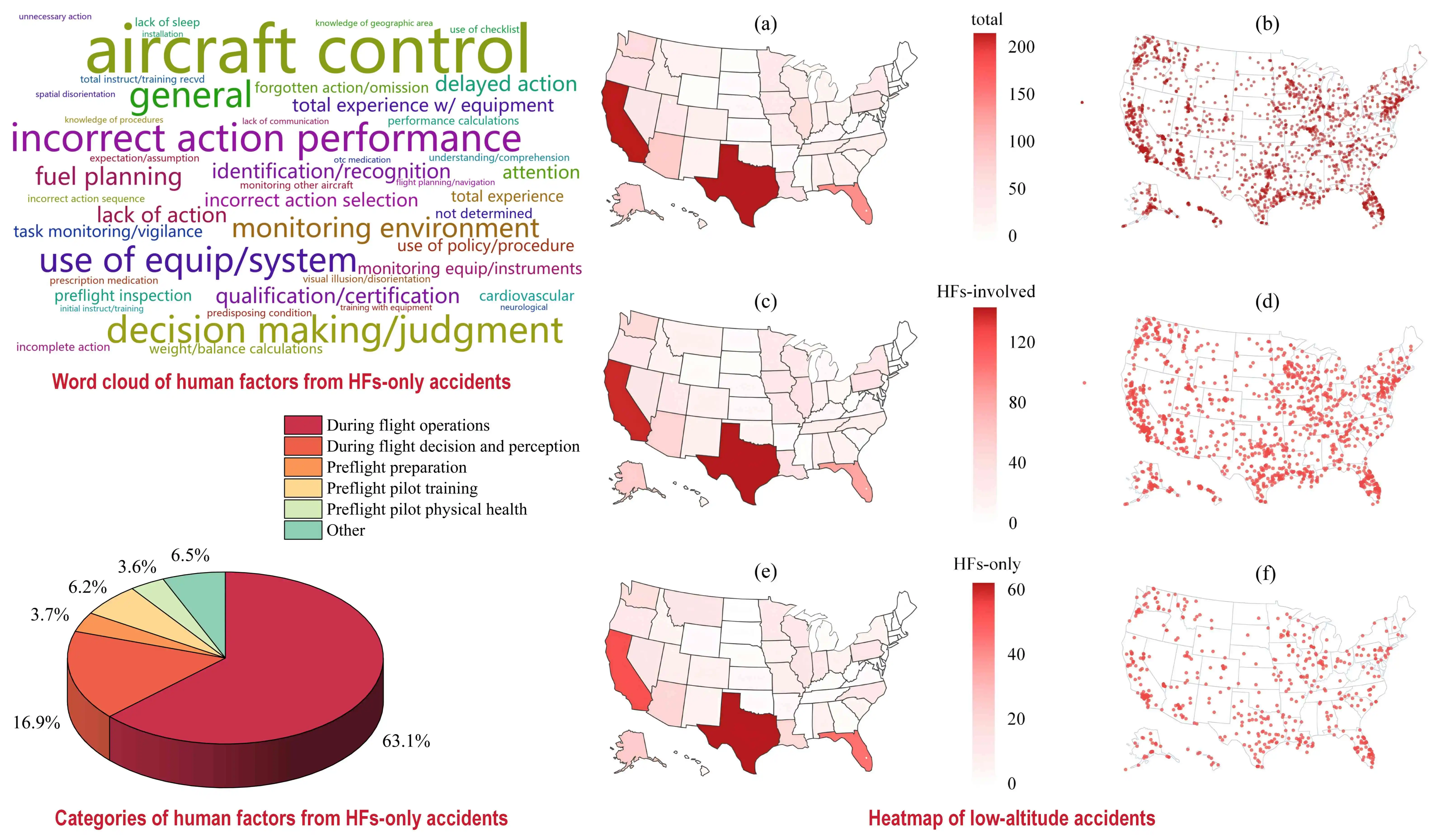
Completed helicopter accidents from 2010 to 2024 were extracted and marked with labels according to the involvement of human factors in the accident causes through a manual-large language model hybrid framework. Variables associated with pilot information were extracted and statistical analysis based on logit regression model was conducted for determinants of occurrence and severity of the HFs-only accidents.
Main contributions of Research 1:
1) Proposed a manual-LLM hybrid framework to extract HFs-only accidents data from NTSB.
2) Investigated determinants of occurrence and severity of HFs-only accidents.
3) Developed pilot qualification policy for safety assurance of AAM.
Research 2: Incorporating pilot mental stress into no-fly zone boundaries through a human factors approach to safe separation design in urban air mobility.
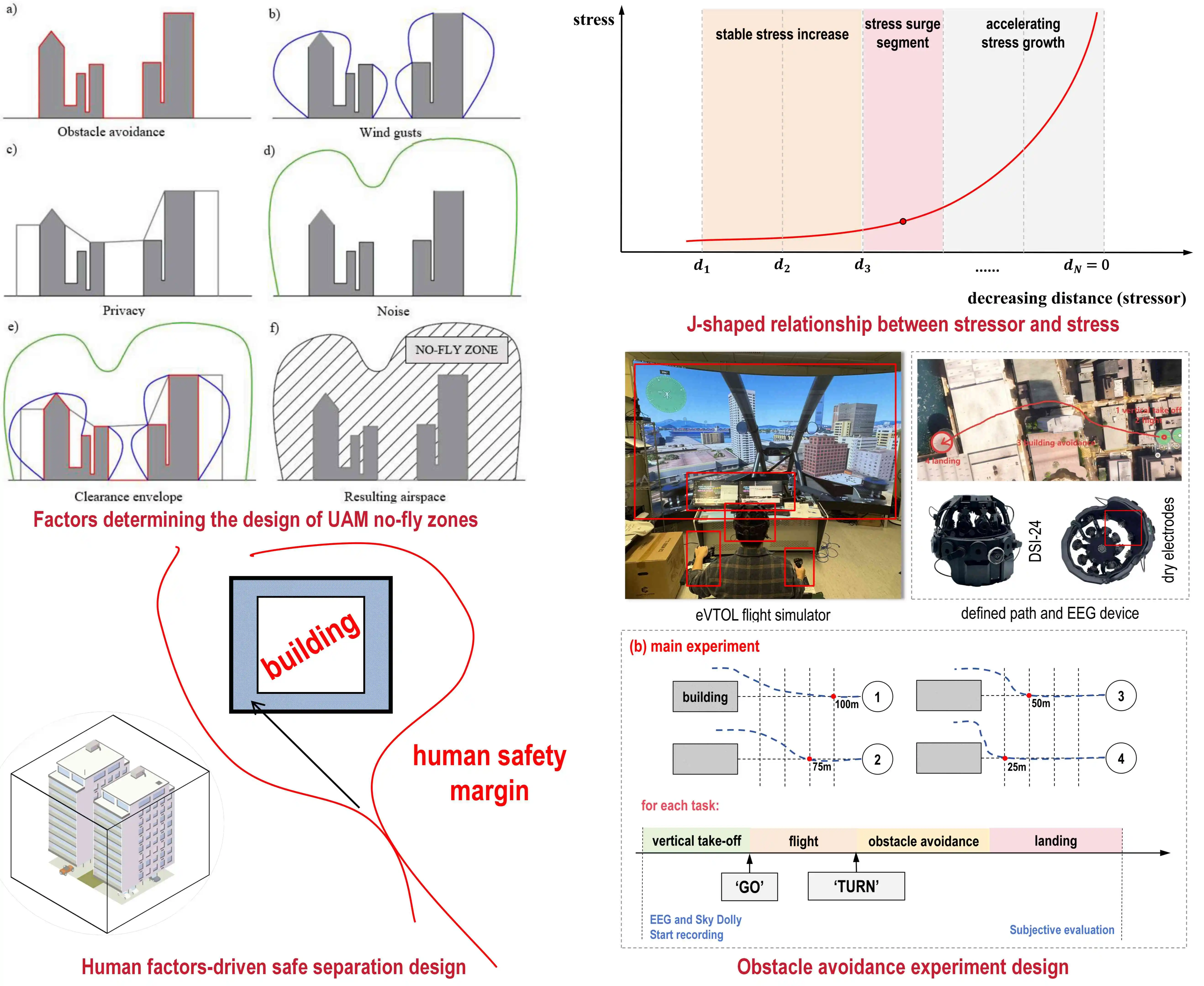
This study aimed to include human factors into the spatial envelop design of no-fly zones in low-altitude airspace. Psychological, physiological and behavioral indicators were extracted to reflect stress levels and capture the distance showing the surge of stress. To calculate the individual overall stress from the three modalities of indicators, this study proposed a J-shape guided multi-feature fusion framework through extracting the properties of monotonic increasing and slope increasing from the J-shape relationship between stressors and stress to execute reliable individual-level fusion.
Main contributions of Research 2:
1) Incorporated HFs (mental stress) into design of low-altitude no-fly zone boundary.
2) Proposed a J-shaped multi-feature fusion framework for stress quantification.
3) Proposed a 75 m safe separation with TTC = 3.18 s as an engineering design reference of HFs-driven no-fly boundary.
Research 3: Separation Assurance in Low-Altitude Cross-Sea Corridors: Investigating the effects of Nearby eVTOL Encounters on Pilots’ Self-Speed Perception Bias.
.webp)
This study aimed to incorporate this human factor into separation assurance in AAM corridors through examining the effects of nearby eVTOL motion and spatial configuration on pilots’ self-speed perception. Forty-one participants completed speed perception under 36 simulated flight conditions through a 2 (relative speed difference: 10 and 20 knots) × 3 (lateral position: -20, 0 and +20 m) × 6 (longitudinal separation: 0-50, 50-100, 100-150, 150-200, 200-250 and 250-300 m) within-participant design. Subjective ratings and electroencephalograph (EEG) patterns were used to represent the joint speed perception response. Repeated-measures multivariate analysis of covariance (RM-MANCOVA) was conducted adopting sleep duration, operational proficiency and threat sensitivity as covariates. Results showed that relative speed difference, lateral position and longitudinal separation produced significant multivariate main effects on the joint speed perception response (P < 0.001) and the interactions were also significant (P < 0.05), but none of the covariates were significantly associated with the joint speed perception response.
Main contributions of Research 3:
1) Incorporated HFs (speed perception bias) into design of safe separation between aircraft in low-altitude cross-sea air corridors.
2) Providing a direct empirical evidence to explain how nearby traffic influences pilots’ speed perception during low-altitude cross-sea flight with limited visual references.
Key Publications
Journal Paper
[1] Zhou, Q., & Ng, K. K. (2026). Incorporating pilot mental stress into no-fly zone boundaries through a human factors approach to safe separation design in urban air mobility. Reliability Engineering & System Safety, 113063.
[2] Zhou, Q., Ng, K. K., Li, W. C., & Braithwaite, G. (2027). Lessons learned from Low-Altitude Accident Reports Utilising Artificial Intelligence for Developing Future Advanced Air Mobility Policy. Transportation Research Part A: Policy and Practice. (Under 2nd Revision)
[3] Zhou, Q., Ng, K. K., & Gu, X. (2027). Safe Separation Assurance in Low-Altitude Cross-Sea Corridors: Effects of Relative eVTOL Motion on Pilot Airspeed Perception Bias. Safety Science. (In preparation)
Conference Paper
[1] Zhou, Q., Ng, K. K., Li, Q., Yiu, C. Y., & Yuan, X. (2025). Investigating Air Taxi Pilot’s Stress Response to Meteorological Changes Utilising an eVTOL Simulator. In AIAA AVIATION FORUM AND ASCEND 2025 (p. 3306).
[2] Zhou, Q., & Ng, K. K. (2026, June). Establishing Human Factors-Driven No-Fly Zone for Manned eVTOLs in Urban Air Mobility. In International Conference on Human-Computer Interaction (pp. 305-317). Cham: Springer Nature Switzerland.
[3] Ng, K. K., Zhou, Q., Li, Q., Yiu, C. Y., Yuan, X., & Bu, Y. (2025, May). Design and Develop Human Factors-Driven Safe Altitude for eVTOLs Operation in Regional Air Mobility. In International Conference on Human-Computer Interaction (pp. 83-94). Cham: Springer Nature Switzerland.
Awards
National Scholarship, 2024, Ministry of Education of the People’s Republic of China, SSY202318360.