Research Interest: Aircraft wake vortex estimation; Flight separation and safety
Education
B.S., Aircraft Airworthiness, School of Transportation Science and Engineering, Beihang University, Beijing, China, 201409 – 201807
M.S., Vehicle Operation Engineering, School of Transportation Science and Engineering, Beihang University, Beijing, China, 201809 – 202101
Ph.D., Aviation Engineering, Department of Aeronautical and Aviation Engineering, Hong Kong Polytechnic University, HKSAR, China, 2022.01-2025.04
International Visit
Visiting Ph.D. Student, French Civil Aviation University (ENAC, Ecole Nationale de l'Aviation Civile), 2024.03- 2024.08
Signature research outcomes

Core Research
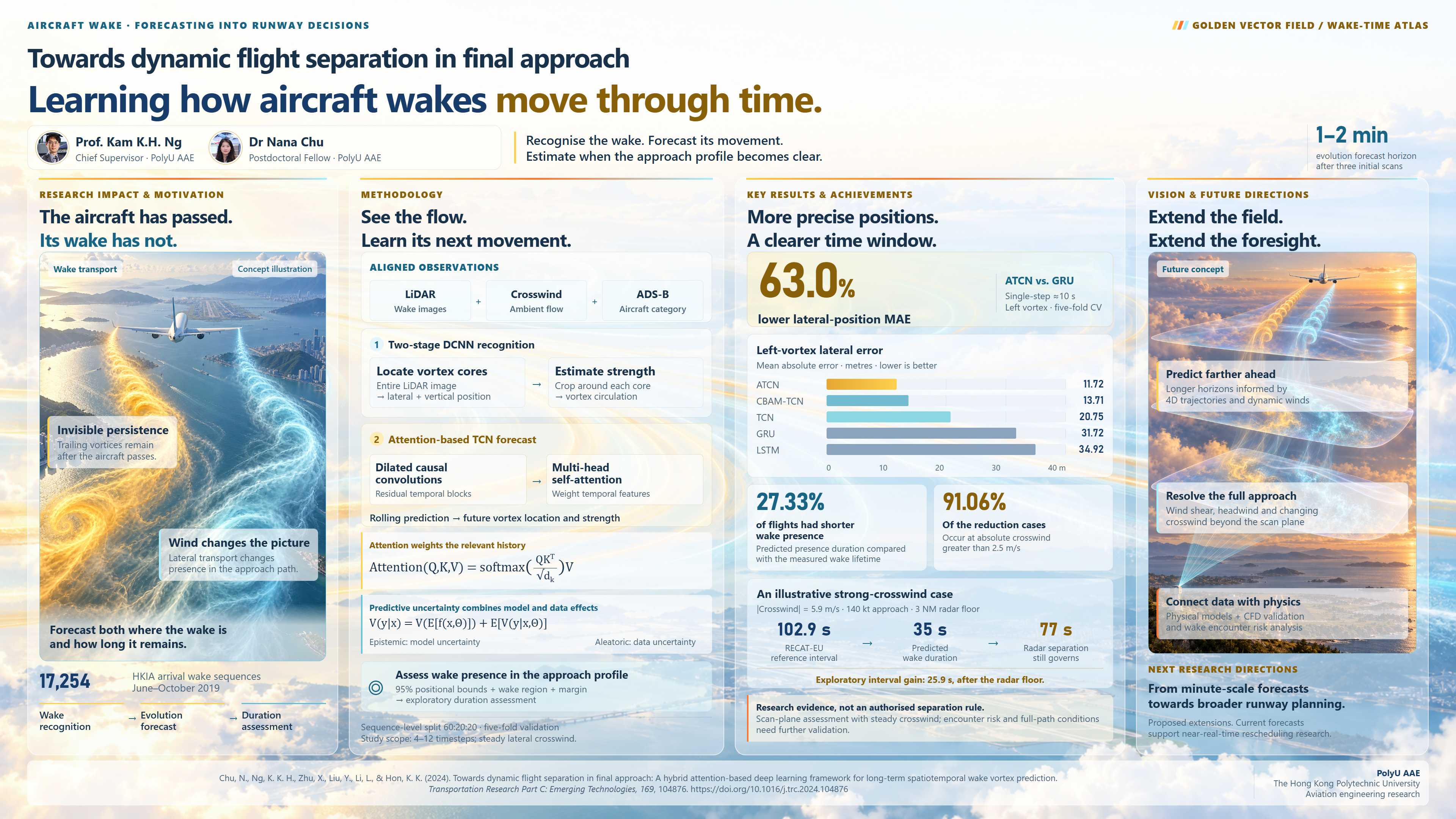
Research 1: Towards dynamic flight separation in final approach: A hybrid attention-based deep learning framework for long-term spatiotemporal wake vortex prediction.
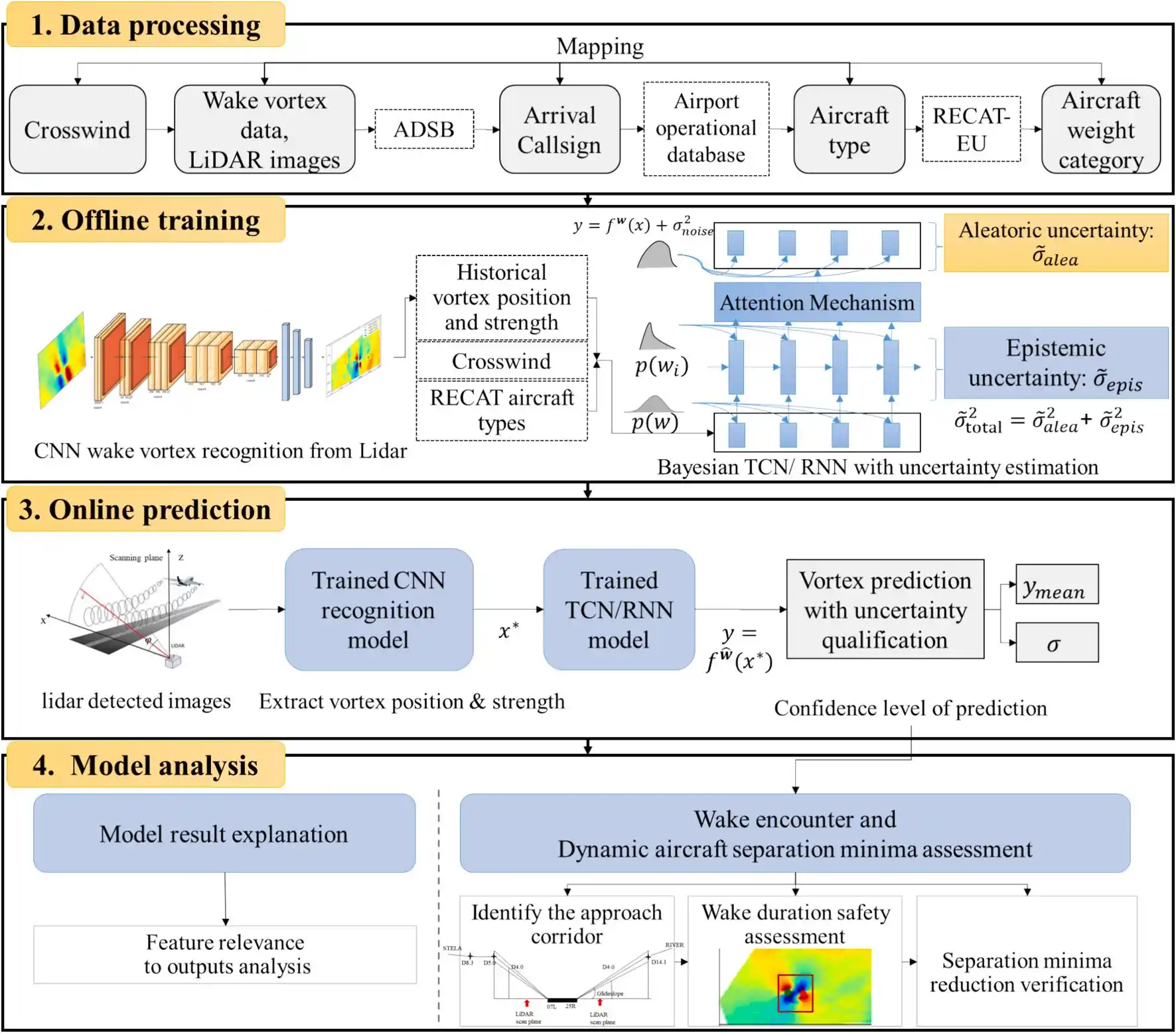
The conservative and distance-based static wake vortex-related separation may restrict runway operational efficiency. Recent studies have demonstrated the potential of wake separation reduction under the Re-categorisation scheme of Aircraft Weight (RECAT). Furthermore, dynamic time-based flight separation considering vortex evolution with respect to aircraft pairs and meteorological conditions will be the ultimate objective for improving runway operational capacity without compromising safety. This paper presents a hybrid deep learning framework for aircraft wake vortex recognition, evolution prediction, and preliminary dynamic separation assessment in the final approach.
Main contributions of Research 1:
1) In terms of the overall methodology, we develop a hybrid deep learning framework to enable online spatiotemporal vortex feature recognition and future evolution projection. The hybrid deep learning framework includes two parts: a two-stage DCNN framework that is adept at capturing spatial features of vortex locations and strength; and attention-based TCN models that are ideal for forecasting the long-term temporal dependencies in vortex transport and decay.
2) For model performance validation, the efficiency of the proposed ATCN models and hybrid DCNN-ATCN strategy is assessed using real flight data and wake data at the Hong Kong International Airport, encompassing several scenarios of background turbulence. This model fusion reveals superior performance compared to benchmarking methods.
3) In vortex duration assessment, both aleatoric uncertainty and epistemic uncertainty of the proposed model for predicting vortex location are characterised by Gaussian distribution. The dynamic separation minima regarding crosswinds are determined by the presence of vortices in the approach profiles and verified from several aspects. Our preliminary results of dynamic separation minima show compliance with the current RECAT-EU standard, and also indicate the effect of strong crosswinds on separation reduction.
Research 2: Coordinated arrival scheduling with dynamic wake separation to mitigate upstream bottlenecks and unlock terminal capacity.
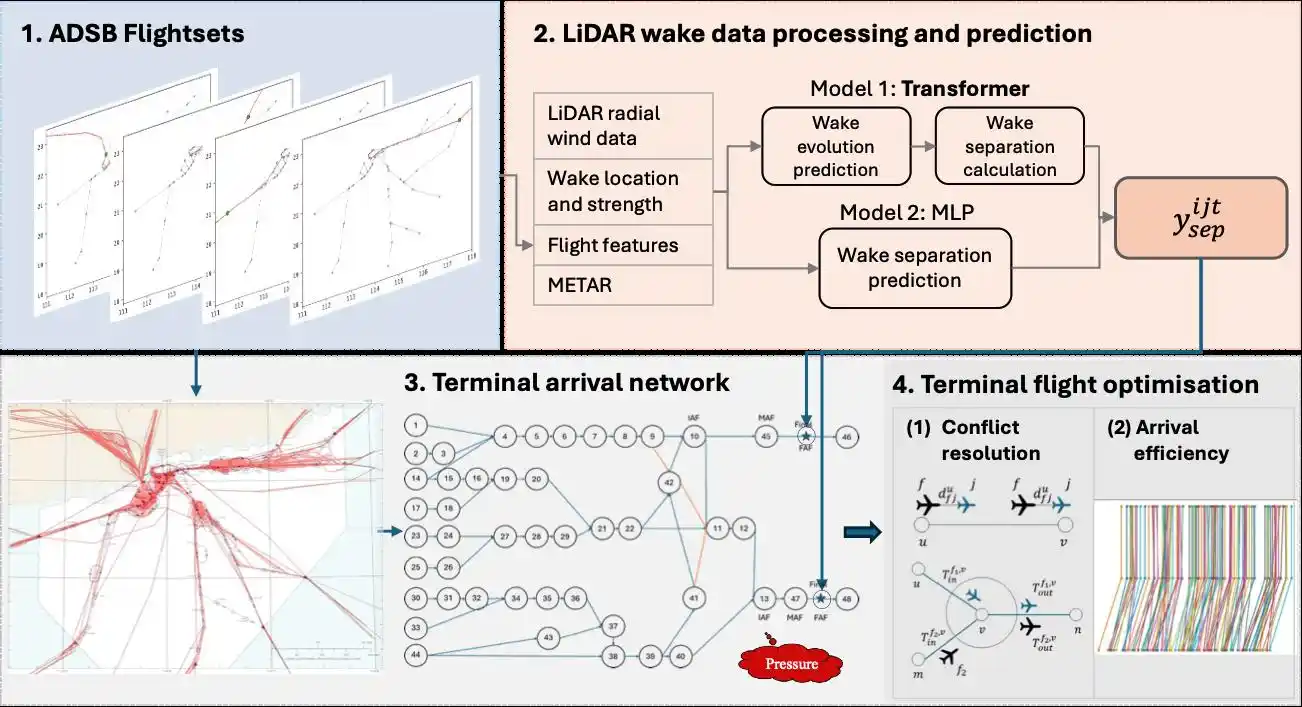
Static wake-turbulence separation standards constrain runway throughput and can propagate congestion into terminal operations. Weather-adaptive, time-based wake separation can reduce unnecessary buffers, but the extent to which these runway-side gains translate into system-level benefits depends on coordinated terminal scheduling. This paper proposes a prescriptive framework that converts data-driven wake observations into an actionable separation indicator and evaluates the system-level impacts of dynamic wake separation through collaborative terminal–runway arrival scheduling.
Main contributions of Research 2:
1) Static wake-turbulence separation standards constrain runway throughput and can propagate congestion into terminal operations. Weather-adaptive, time-based wake separation can reduce unnecessary buffers, but the extent to which these runway-side gains translate into system-level benefits depends on coordinated terminal scheduling. This paper proposes a prescriptive framework that converts data-driven wake observations into an actionable separation indicator and evaluates the system-level impacts of dynamic wake separation through collaborative terminal–runway arrival scheduling.
2) We formulate a collaborative terminal–runway scheduling model that jointly enforces conflict-free terminal operations and weather-adaptive separation on final approach. A fixed-trajectory runway-only baseline further shows that reduced final-approach separation mainly relieves the active final segment, whereas coordinated terminal rescheduling is required to remove upstream bottlenecks and realize system-level gains.
3) We establish a prediction-then-optimize framework of terminal arrival management that links Transformer-based wake prediction, separation construction, and terminal-network scheduling for operational-scale assessment. For large instances, a tailored priority-structured selective annealing heuristic is used as a practical solution strategy, and benchmark tests against Gurobi on tractable instances support its computational applicability. The HKIA case study demonstrates considerable hourly throughput gains under dynamic separation with only marginal delay impacts.
Key Publications
Journal Paper
[1] N. Chu, Ng, K. K. H., Liu, Y., Hon, K. K., Chan, P. W., Li, J., & Zhang, X. (2024). Assessment of approach separation with probabilistic aircraft wake vortex recognition via deep learning. Transportation Research Part E: Logistics and Transportation Review, 181, 103387. https://doi.org/10.1016/j.tre.2023.103387
[2] N. Chu, Ng, K. K., Zhu, X., Liu, Y., Li, L., & Hon, K. K. (2024). Towards dynamic flight separation in final approach: A hybrid attention-based deep learning framework for long-term spatiotemporal wake vortex prediction. Transportation Research Part C: Emerging Technologies, 169.
Conference Paper
[1] N. Chu, C. Zhang, K.K.H. Ng, D. Delahaye. (2025). Unlocking Runway Capacity: Enhancing Efficiency through Dynamic Pairwise Aircraft Wake Separation. ATRD Symposium 2025, Eurocontrol FAA, Jun 2025, Prague, Czech Republic. hal-05131139.
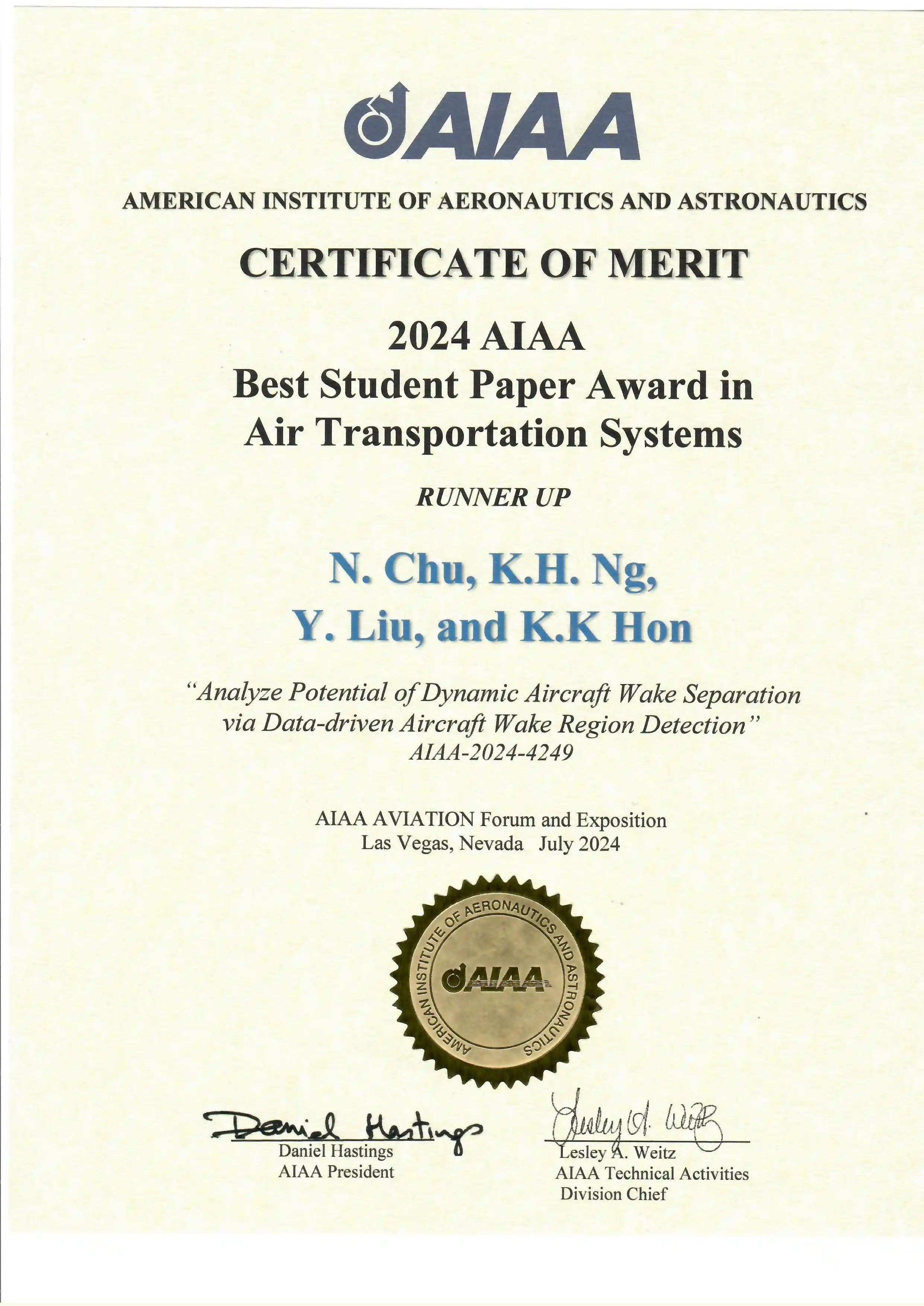
[2] N. Chu, K.K.H. Ng*, Y. Liu, K.K. Hon. (2024). Analyze the potential of dynamic aircraft wake separation via data-driven aircraft wake region detection. In AIAA AVIATION 2024 Forum. https://doi.org/10.2514/6.2024-4249 (Best Student Paper)
Awards
Best Student Paper (Runner-Up) in 2024 AIAA Aviation Forum
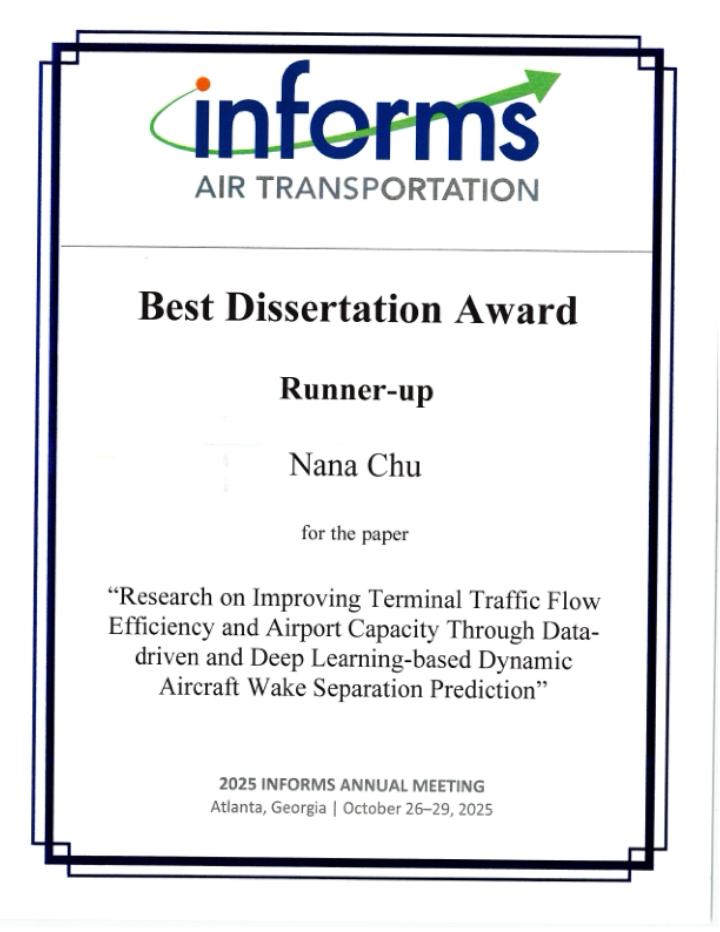
Best PhD Dissertation (Runner-Up) in 2025 Informs Annual Meetings