
Research Interest: Adaptive AI for Aviation Safety; Human Factors and Neuro-ergonomics; Human-AI Interaction and Teaming; Human Performance in Emerging Concepts of Operations; Intelligent Aircraft Maintenance for Aviation Safety
Education
B.Eng. (Hons) in Aviation Engineering (First Class Honours), Department of Aeronautical and Aviation Engineering, The Hong Kong Polytechnic University, Hong Kong, 2018/09-2022/06
Minor in Applied Psychology (GPA: 3.90/4.30), Department of Applied Social Sciences, The Hong Kong Polytechnic University, Hong Kong, 2020/01-2022/06
Ph.D. in Aviation Safety and Human Factors, Human Factors and Ergonomics Laboratory, Department of Aeronautical and Aviation Engineering, The Hong Kong Polytechnic University, Hong Kong, 2022/08-2026/05
Employment
Postdoctoral Fellow, Department of AAE, The Hong Kong Polytechnic University, 06/2026 – Present
Project Assistant, Department of AAE, The Hong Kong Polytechnic University, 07/2022 – 08/2022
Student Assistant, Department of AAE, The Hong Kong Polytechnic University, 02/2021 – 06/2022
Intern, Department of AAE, The Hong Kong Polytechnic University, 12/2020 – 01/2021
International Visit
Visiting Ph.D. Research Student, Safety and Accident Investigation Centre, Cranfield University, United Kingdom, 2025/04-2026/03
Signature research outcomes
Core Research
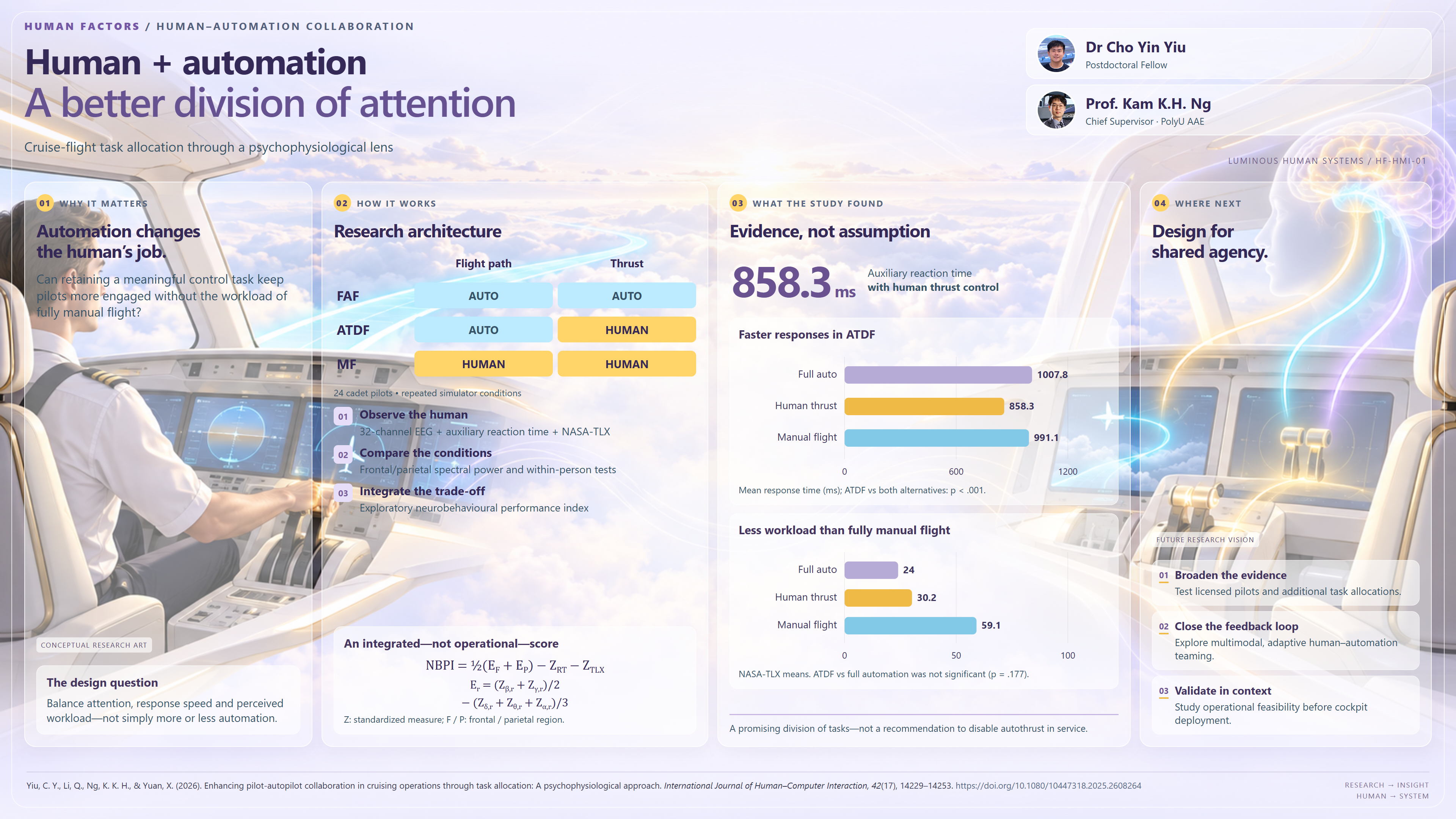
Research 1: Enhancing pilot-autopilot collaboration in cruising operations through task allocation: A psychophysiological approach.
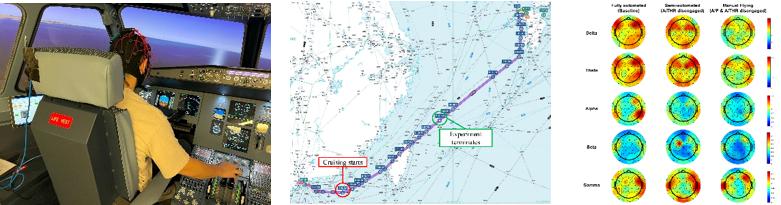
This research seeks a cockpit automation solution that balances human and task performance with a minimal trade-off in cognitive workload. A performance index was proposed to evaluate human and task performance in each level of automation. Our study empirically concluded that an effective task distribution enhances human-automation teaming and provides design insights on cockpit automations.
Main contributions of Research 1:
1) This research enhances HAI via an adaptive automation solution in cruising flight with a rigorous analysis of neural markers that balance human OOTL, task performance, and cognitive workload.
2) This study contributes by empirically examining how different LOAs, including fully automated flight (FAF), auto-thrust disengaged flight (ATDF), which is a form of PAF, and manual flight (MF), impact pilots’ performance during cruising.
3) Based on EEG band power, reaction time, and cognitive workload, we further propose a holistic and balanced quantitative evaluation framework that examines how “well” an automation configuration performs.
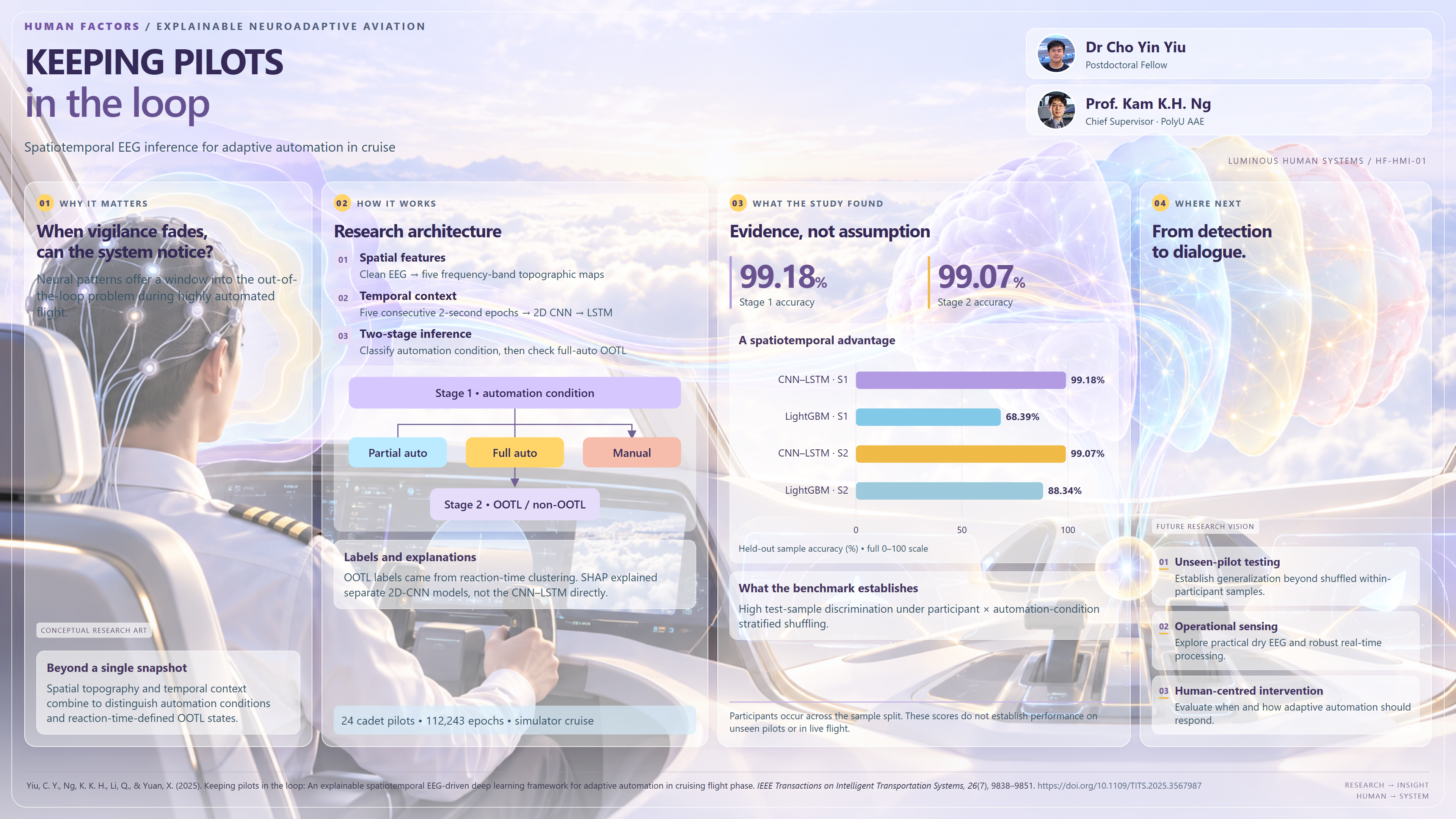
Research 2: Keeping pilots in the loop: An explainable spatiotemporal EEG-driven deep learning framework for adaptive automation in cruising flight phase.
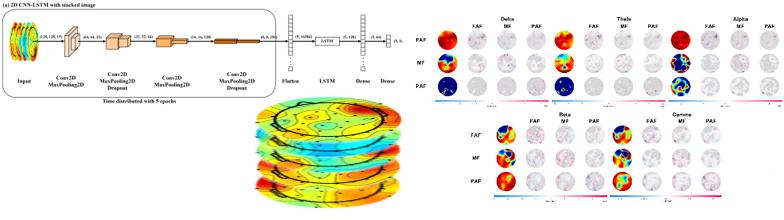
This research proposes a two-stage explainable adaptive automation approach to keep pilots in the loop based on Convolutional Neural Networks, Long Short-Term Memory, and EEG data collected from 24 participants in a one-hour simulator-based flight task in each level of automation. Shapley additive explanations are adopted to strengthen the model interpretability and trustworthiness for safety-critical applications. Our model successfully identified that high delta and theta waves with low beta and gamma waves contribute positively to the out-of-the-loop state. The trustworthy adaptive deep learning model supports the dynamical automation configuration for improving human-automation collaboration in cruising flights.
Main contributions of Research 2:
1) This research captures the underlying cognitive mechanisms with EEG to reflect human performance objectively.
2) Based on the classified mental state of pilots, both human and task performance can be optimised dynamically by tuning the LOA. This approach advances HAI by addressing the limitations of a static LOA throughout the entire cruising flight.
3) An explainable artificial intelligence (XAI) approach is adopted to facilitate the understanding of brain regions activated during different LOAs, which strengthens the trustworthiness of the model. This study is original in providing a trustworthy adaptive automation solution in cruising operations rather than merely a ‘black-box’ solution.
Key Publications
Selected Journal Papers
[1] Yiu, C. Y., Li, Q., Ng, K. K. H.*, & Yuan, X. (2026). Enhancing pilot-autopilot collaboration in cruising flight phase through task allocation: A psychophysiological approach. International Journal of Human-Computer Interaction. doi:10.1080/10447318.2025.2608264. (IF: 6.1, JCR: Q1)
[2] Yiu, C. Y., Li, W.-C., Ng, K. K. H.*, Chi, C.-F., & Schiefele, J. (2026). Enhancing aviation safety with artificial intelligence: A systematic literature review on recent advances, challenges and future perspectives. Advanced Engineering Informatics, 71, 104378. doi:10.1016/j.aei.2026.104378. (IF: 11.5, JCR: Q1)
[3] Yiu, C. Y., Ng, K. K. H., Chan, F. T. S.*, & Li, Q. (2023). Vaccines, associated risk and air transport industry post-COVID-19: A structural equation modelling-based empirical study in Hong Kong. Research in Transportation Business & Management, 50, 101038. doi:10.1016/j.rtbm.2023.101038. (IF: 4.8, JCR: Q2)
[4] Yiu, C. Y., Ng, K. K. H.*, Li, Q., & Yuan, X. (2025). Gaze behaviours, situation awareness, and cognitive workload of air traffic controllers in radar screen monitoring tasks with varying task complexity. International Journal of Occupational Safety and Ergonomics, 31(2), 504-515. doi:10.1080/10803548.2025.2453312. (IF: 1.8, JCR: Q3)
[5] Yiu, C. Y., Ng, K. K. H.*, Li, Q., & Yuan, X. (2025). Keeping pilots in the loop: An explainable spatiotemporal EEG-driven deep learning framework for adaptive automation in cruising flight phase. IEEE Transactions on Intelligent Transportation Systems, 26(7), 9838-9851. doi:10.1109/TITS.2025.3567987. (IF: 9.1, JCR: Q1)
[6] Yiu, C. Y., Ng, K. K. H.*, Li, X.*, Zhang, X., Li, Q., Lam, H. S., & Chong, M. H. (2022). Towards safe and collaborative aerodrome operations: Assessing shared situational awareness for adverse weather detection with EEG-enabled Bayesian neural networks. Advanced Engineering Informatics, 53, 101698. doi:10.1016/j.aei.2022.101698. (IF: 11.5, JCR: Q1)
[7] Yiu, C. Y., Ng, K. K. H.*, Yu, S. C. M., & Yu, C. W. (2022). Sustaining aviation workforce after the pandemic: Evidence from Hong Kong aviation students toward skills, specialised training, and career prospects through a mixed-method approach. Transport Policy, 128, 179-192. doi:10.1016/j.tranpol.2022.09.020. (IF: 6.2, JCR: Q1)
Selected Conference Papers
[1] Yiu, C. Y.#, Ng, K. K. H.*, Li, Q., & Yuan, X. (2024, May). How do the levels of automation in flight operations affect pilots’ cognitive workload, reaction time, and EEG brain waves in cruising flights? In The 4th IEEE International Conference on Human-Machine Systems (pp. 1-6). Toronto, Canada: IEEE.
[2] Yiu, C. Y.#, Ng, K. K. H.*, Li, Q., & Yuan, X. (2025, June). Identifying human out-of-the-loop in cruising flights using EEG spectral features with deep learning. In 27th International Conference on Human-Computer Interaction. Gothenburg, Sweden: Springer.
[3] Yiu, C. Y.#, Ng, K. K. H.*, Wong, K. Y., Wong, W. H., & Lam, K. W. (2023, July). On the significance of using event-related potentials and gaze behaviours to evaluate inflight emergency training performance. Paper presented at the 26th ATRS World Conference, Kobe, Japan.
[4] Yiu, C. Y.#, Tam, T. K., & Ng, K. K. H.* (2021, December). An ADS-B aided dynamic traffic alert for robust safety assessment in controlled airspace. In The 2021 IEEE International Conference on Industrial Engineering and Engineering Management (pp. 319-323). Singapore, Singapore: IEEE.
[5] Yiu, C. Y.#, Zhou, Q., Li, Q., Yuan, X., & Ng, K. K. H.* (2025, July). Enhancing the human performance of eVTOL pilots in skyscraper-constrained urban air mobility environments. In AIAA AVIATION 2025 Forum and ASCEND. Las Vegas, NV: AIAA.
Awards
[1] Outstanding Young Alumni Award in Scholarly Achievement, Department of AAE, PolyU, 2026
[2] Best Paper Award, HKIE-LTD Best Student Papers Awards 2022/23, The Hong Kong Institution of Engineers – Logistics and Transportation Division, 2023
[3] Outstanding Award, Postgraduate Level, CA Paper Award Competition 2021/22, The Hong Kong Institution of Engineers - Control, Automation & Instrumentation Division, 2022
[4] Outstanding Student Award, Department of AAE, PolyU, 2021