
Research Interest: Autonomous UAV Guidance, Navigation, and Control
Education
BEng, Mechanical Engineering, The University of Hong Kong, 2012 – 2015
MSc, Mechanical Engineering, The Hong Kong University of Science and Technology, 2017 ‑ 2018
PhD, Aviation Engineering, The Hong Kong Polytechnic University, 2021 ‑ 2025
Signature research outcomes

Core Research
Research 1: Time-Optimal Motion Planning Using a Novel Curve-Framing Method.
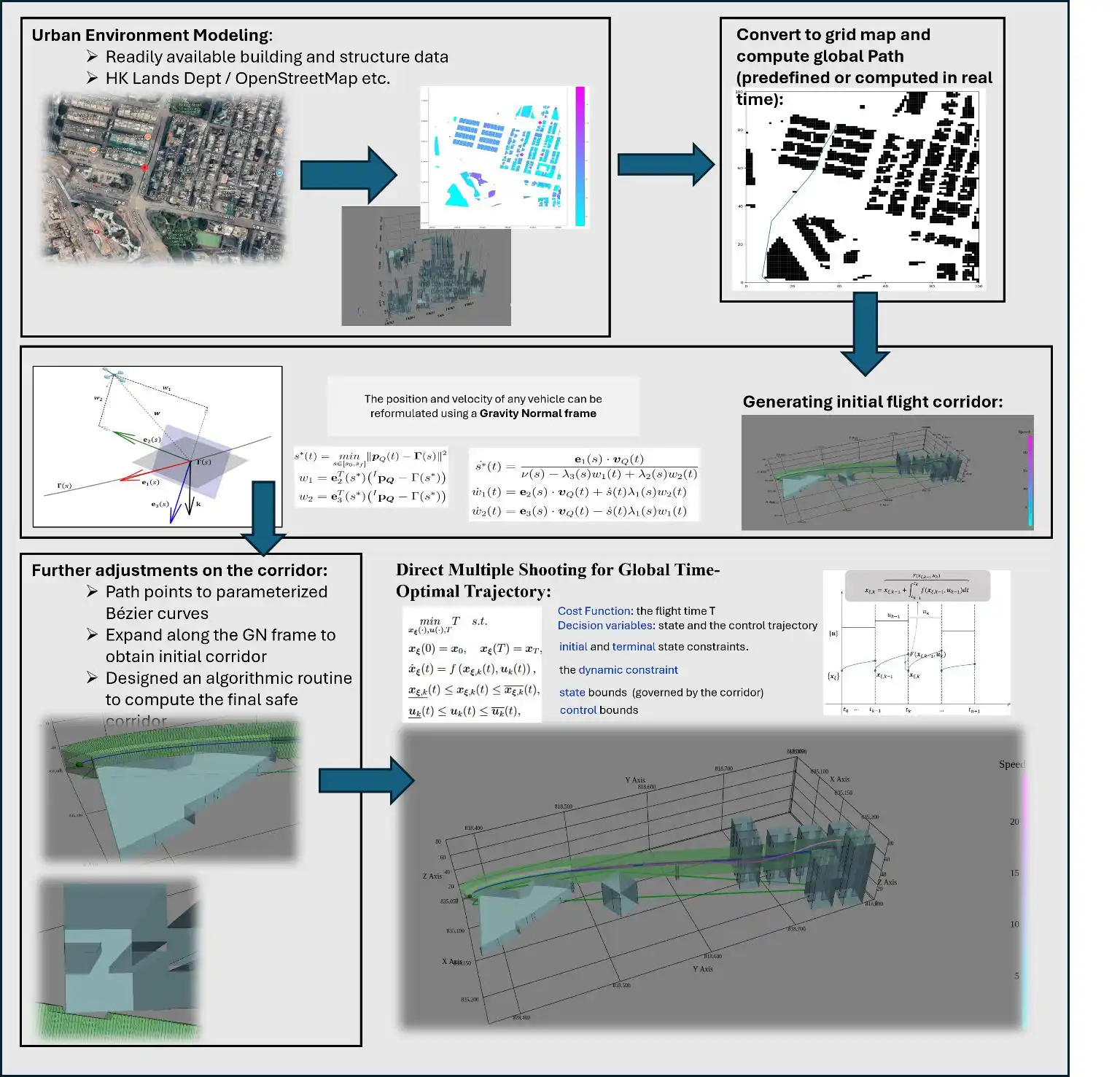
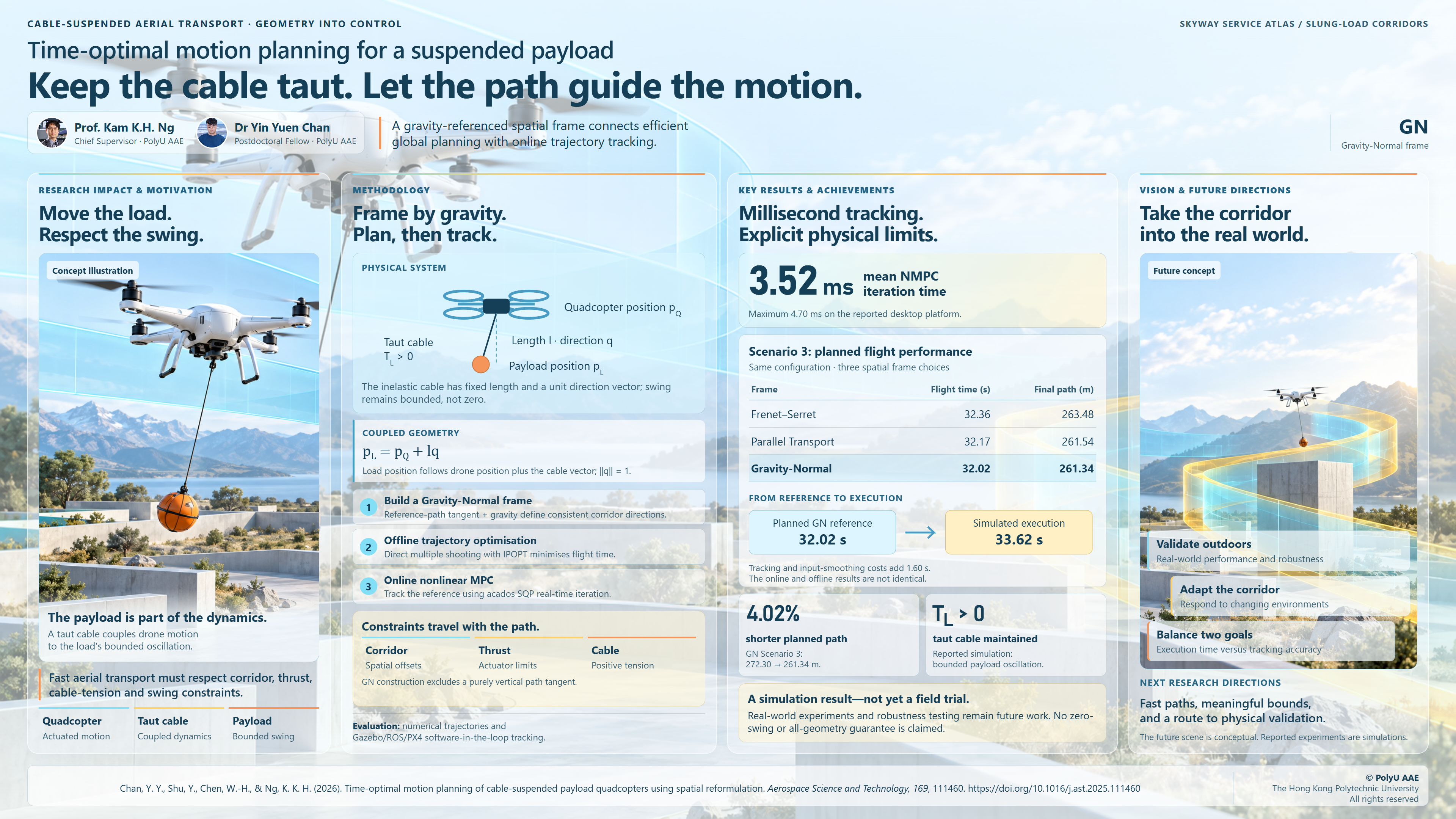
This research addresses fast and safe payload transportation by cable-suspended payload quadcopters (CSPQs) while limiting payload swing and satisfying flight-corridor constraints. Given the system’s nonlinear and underactuated dynamics, trajectory generation and tracking are formulated as constrained optimal control problems. A hierarchical framework is developed through spatial reformulation relative to a global reference path. Unlike Frenet–Serret and parallel-transport frames, the Gravity Normal frame is singularity-free, physically interpretable, and analytically computable, with axes aligned with gravity and lateral motion. It also transforms geometric corridor constraints into linear or norm-bounded constraints. The first layer generates an offline time-optimal trajectory using direct multiple shooting, while the second employs nonlinear model predictive control (NMPC) for online trajectory tracking, swing suppression, and obstacle avoidance.
Main contributions of Research 1:
1) A singularity-free spatial transformation for CSPQ systems based on the Gravity Normal frame.
2) A safe-flight-corridor construction method based on the transverse coordinates of the reference path, addressing the nonconvexity introduced when convex obstacles in three-dimensional Euclidean space are spatially reformulated.
3) A unified hierarchical framework for CSPQ motion planning that naturally formulates time-optimal trajectory generation and employs an NLP-based NMPC scheme for trajectory tracking and obstacle avoidance.
Research 2: Invariant Kalman Filtering for Joint UAV State and Wind Estimation.
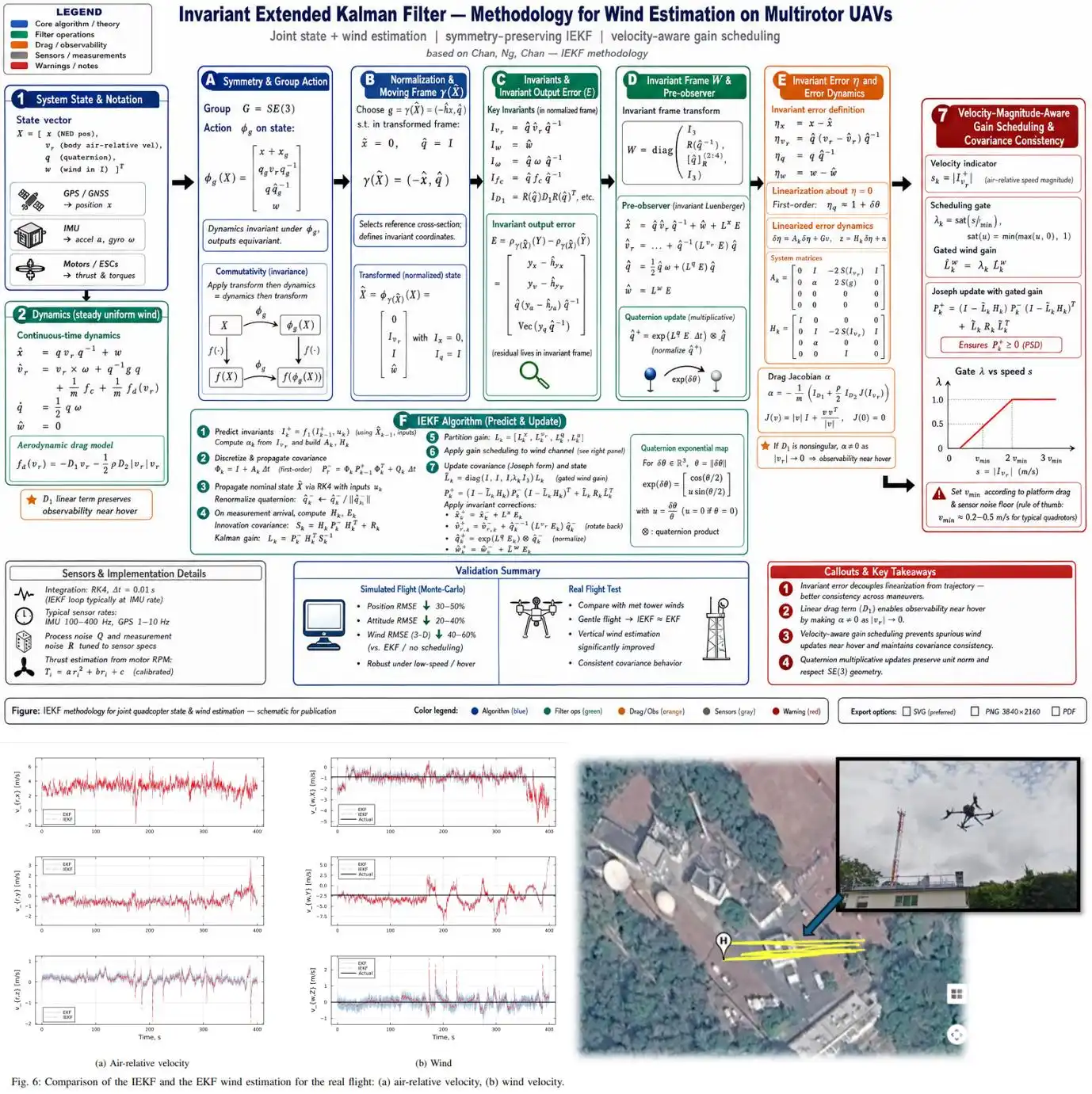
This research proposes an invariant extended Kalman filter for joint quadcopter state and wind estimation using onboard sensors from a commercial multirotor unmanned aerial vehicle. The system state includes position, air-relative velocity, attitude, and wind velocity. By leveraging the symmetry of the quadcopter dynamics, the proposed filter constructs an invariant output error and an invariant-coordinate linearized error model with reduced dependence on the estimated trajectory. This allows the correction step to be performed in geometrically consistent coordinates and reduces sensitivity to the state-dependent linearization errors of the conventional extended Kalman filter. Furthermore, the design introduces a velocity-magnitude-aware gain scheduling mechanism that smoothly suppresses the wind correction when the invariant air-relative speed is small, preventing noise-amplified spurious wind updates during near-hover or slow-flight phases while maintaining covariance consistency. The method is validated in numerical simulations and real-flight experiments using a DJI multirotor platform. Simulation results show that the invariant filter provides lower position, wind, and attitude estimation errors, as well as faster convergence, compared with the conventional filter. Real-flight results show comparable performance between the two filters under mild flight conditions, demonstrating the feasibility of onboard wind estimation using commercial drone telemetry without additional wind sensors.
Main contributions of Research 2:
1) An augmented IEKF for joint quadcopter state and wind estimation is implemented and validated on a commercial off-the-shelf multirotor platform, demonstrating the feasibility of using onboard IMU with AHRS and precision GPS measurements for wind estimation without dedicated airflow sensors.
2) A velocity-magnitude-aware gain-scheduling mechanism is introduced to smoothly suppress wind-state corrections at low invariant air-relative speeds, mitigating noise-amplified spurious updates during near-hover and slow-flight conditions.
3) The proposed framework is experimentally evaluated using professional-grade anemometer measurements provided by the Hong Kong Observatory as an independent wind reference.
Key Publications
Selected Journal Papers
[1] Chan, Y. Y., Shu Y. X., Chen, W. H. & Ng, K. K. H. (2026). Time‑Optimal Motion Planning of Cable‑Suspended Payload Quadcopters Using Spatial Reformulation. Aerospace Science and Technology.
[2] Chan, Y. Y., Ng, K. K. H., Wang, T., Hon, K. K., & Liu, C. H. (2025). Near time‑optimal trajectory optimisation for drones in last‑mile delivery using spatial reformulation approach. Transportation Research Part C: Emerging Technologies, 171, 104986.
Selected Conference Papers
[1] Chan, Y. Y., Ng, K. K. H., Liu, Y. (2025). Dynamic Modeling of Cable‑Suspended Payload Quadcopter: A Physics‑Informed Deep Learning Approach. In AIAA AVIATION FORUM AND ASCEND 2025.
[2] Chan, Y. Y., Ng, K. K. H., Liu, C. H., & Hon, K. K. (2024). Wind Dynamics and Homotopy Path Planning for Unmanned Aerial Vehicle Trajectory Optimisation. In AIAA AVIATION FORUM AND ASCEND 2024 (p. 4206).
Patents
周定汉, 陈彦元, 刘显杰, 陈炎材, 李逸曦, 伍淦鸿, “Robot Cooperation System Composed of a Picking Robot and a Delivery Robot”. Chinese Utility Model Patent CN216913853U. Jul. 2022