
Research Interest: Airside operations; Air traffic flow management; Urban low-altitude air traffic system planning and operations.
Education
B.Mgt, Logistics Management, Fuzhou University, 2015.09-2019.06
M.Sc, Industrial Engineering and Logistics Management, The University of Hong Kong, 2020.09-2021.12
Ph.D, Aviation Engineering, The Hong Kong Polytechnic University, 2022.01-2025.04
Signature research outcomes


Core Research
Research 1: Prescriptive Analytics for Airport Gate Assignment Planning.
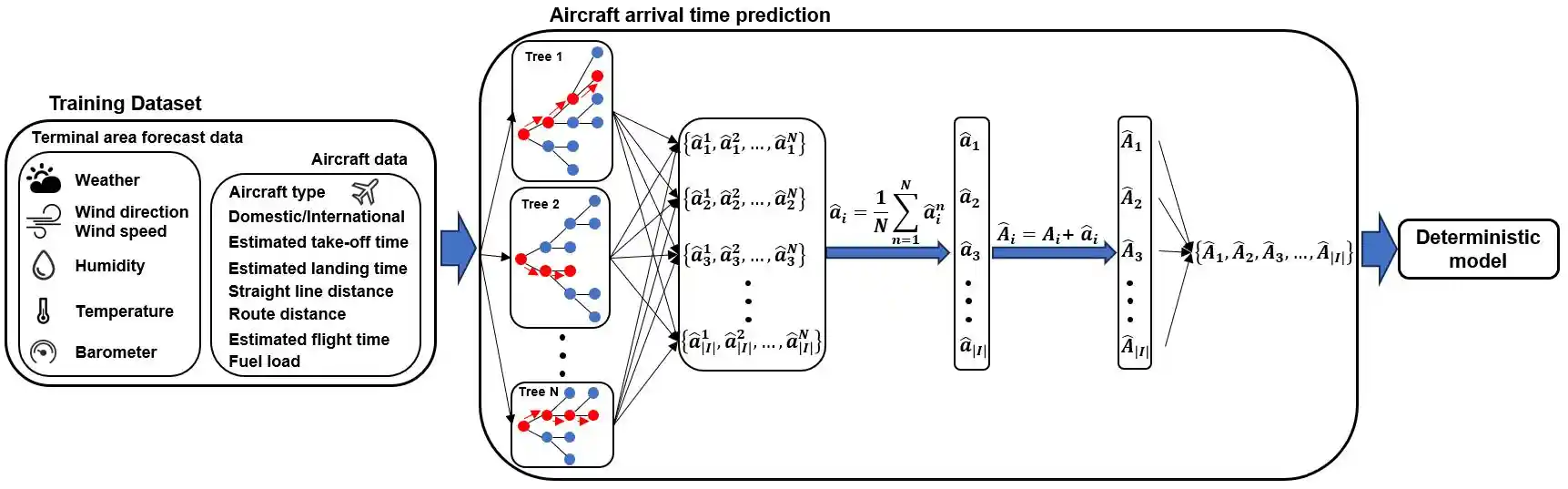
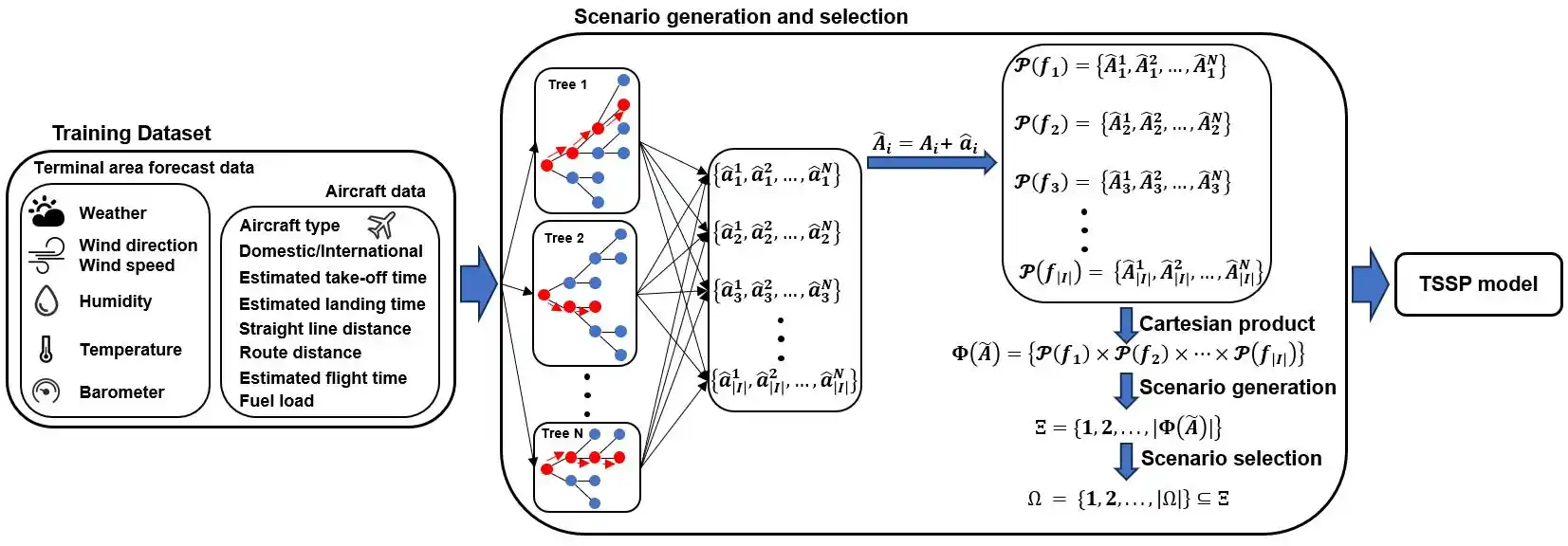
This study develops predict-then-optimise (PTO) and estimate-then-optimise (ETO) approaches for the airport gate assignment problem under uncertainty. Machine learning methods (KNN, RF) are integrated with scenario reduction strategies (CSR, SAA) to improve robustness. A Benders-based branch-and-cut algorithm is designed to solve the stochastic programming model efficiently. Case studies at Xiamen Gaoqi International Airport demonstrate that RF-driven ETO with CSR achieves superior performance.
Main contributions of Research 1:
1) Proposed PTO and ETO frameworks integrating ML predictions with optimisation.
2) Designed clustered-based scenario reduction and Benders-based branch-and-cut methods.
3) Validated effectiveness through real-world airport case studies.
Research 2: Contextual Distributionally Robust Optimisation for Aircraft Sequencing and Scheduling.
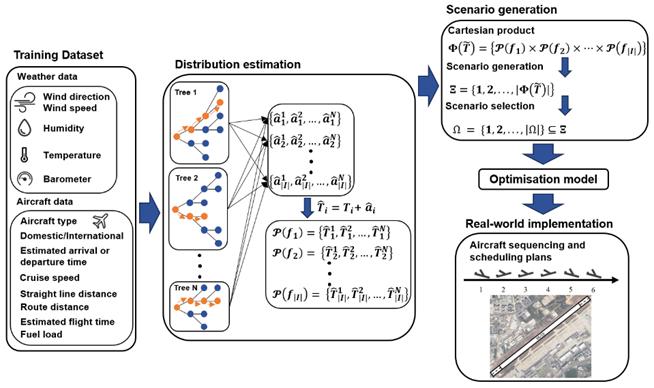
This research addresses the aircraft sequencing and scheduling problem by proposing an estimate-then-distributionally-robust-optimise (ETDRO) approach. A DRO model with a Wasserstein ambiguity set is developed to handle limited data and uncertainty. Exact decomposition methods (DR L-shaped, E-DR BBC) and inexact stabilised methods (S-DR BBC) are designed to solve the DRO efficiently. Numerical experiments at Xiamen Gaoqi International Airport show that ETDRO outperforms traditional stochastic programming approaches in robustness and scalability.
Main contributions of Research 2:
1) Introduced ETDRO framework with Wasserstein ambiguity set for ASSP.
2) Developed exact and inexact decomposition algorithms for DRO.
3) Demonstrated superior robustness and computational efficiency in airport case studies.
Research 3: Contextual Stochastic Programming with Mixed-Integer Recourse for Multi-Runway Aircraft Landing.
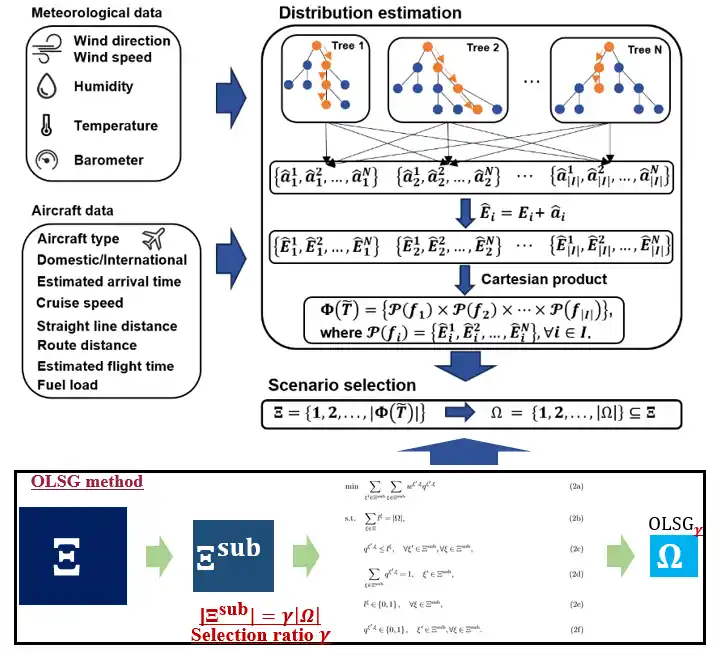
This study proposes a stochastic programming model with mixed-integer recourse (SP-MIR) for the multi-runway aircraft landing problem. Learning-driven scenario generation (LSG) and optimisation-enhanced LSG (OLSG) methods are designed to capture arrival time uncertainty. A novel stabilised branch-and-check (SBAC) method is developed to solve the SP-MIR efficiently. Experiments at Hong Kong International Airport show that SBAC reduces CPU time by over 80% compared to benchmark solvers, while maintaining solution quality.
Main contributions of Research 3:
1) Formulated SP-MIR model for multi-runway aircraft landing under uncertainty.
2) Proposed LSG and OLSG scenario generation methods.
3) Designed SBAC algorithm achieving significant computational efficiency gains.
Key Publications
Journal Paper
[1] Zhang, C., Jin, Z., Ng, K. K., Liu, Y., & Wu, L. (2026). Stabilised branch-and-check method for optimising multi-runway aircraft landing problem modelled through stochastic programming with learning-driven arrival time predictions. Transportation Research Part E: Logistics and Transportation Review, 210, 104763.
[2] Zhang, C., Jin, Z., Ng, K. K. H.*, Tang, T. Q., & Tang, R. (2025). Distributionally robust optimisation approach for aircraft sequencing and scheduling with learning-driven arrival and departure time predictions. OMEGA, 103415.
[3] Zhang, C., Ng, K. K. H.*, Jin, Z., Yao, S., & Qin, Y. (2025). Q-learning-driven exact and meta-heuristic algorithms for the robust gate assignment problem. Advanced Engineering Informatics, 67, 103551.
[4] Zhang, C., Ng, K. K. H.*, Jin, Z., Sun, X., & Qin, Y. (2025). Risk-averse two-stage stochastic programming model for gate assignment problem under arrival time uncertainty. Computers & Industrial Engineering, 111269.
[5] Zhang, C., Jin, Z., Ng, K. K. H.*, Tang, T. Q., Zhang, F., & Liu, W. (2025). Predictive and prescriptive analytics for robust airport gate assignment planning in airside operations under uncertainty. Transportation Research Part E: Logistics and Transportation Review, 195, 103963.