
Research Interest: Clear-Air Turbulence; Air Traffic Management
Education
B.Eng, Transportation Engineering, Civil Aviation University of China, 2014.09-2018.06
M.Eng, Transportation Engineering, Nanjing University of Aeronautics and Astronautics, 2018.09-2021.06
M.Sci, Data Science, University of Nottingham, 2021.09-2022.12
Ph.D, Aviation Engineering, The Hong Kong Polytechnic University, 2024.01-present
Empolyment
Software Engineer, Xiamen Airline, 2023.6-2023-12.
International Visit
International Visit Student, Ecole Nationale de l'Aviation Civile, 2026.1-2026.7.
Signature research outcomes

Core Research
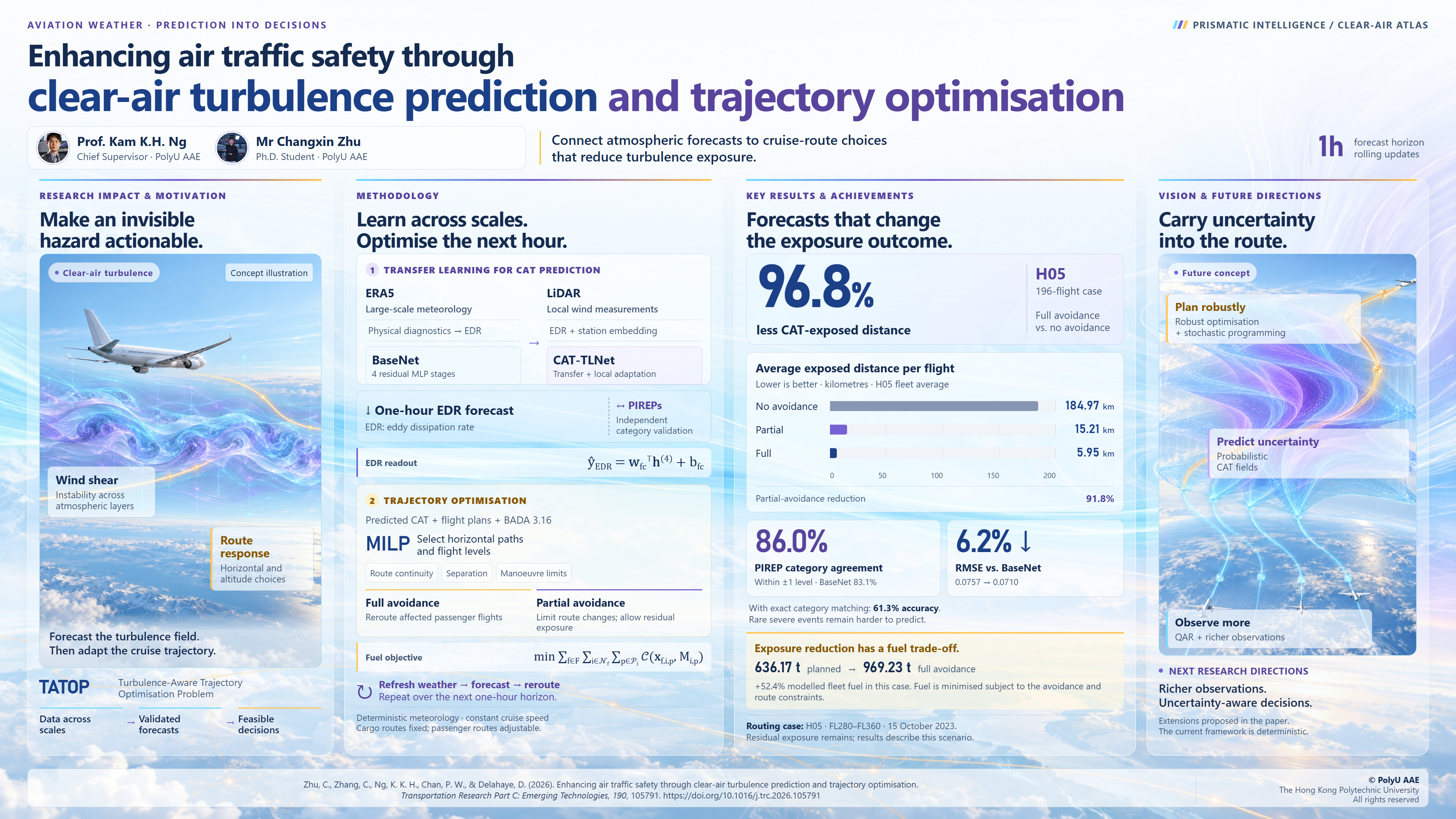
Research 1: Enhancing Air Traffic Safety Through Clear-air Turbulence Prediction and Trajectory Optimisation.
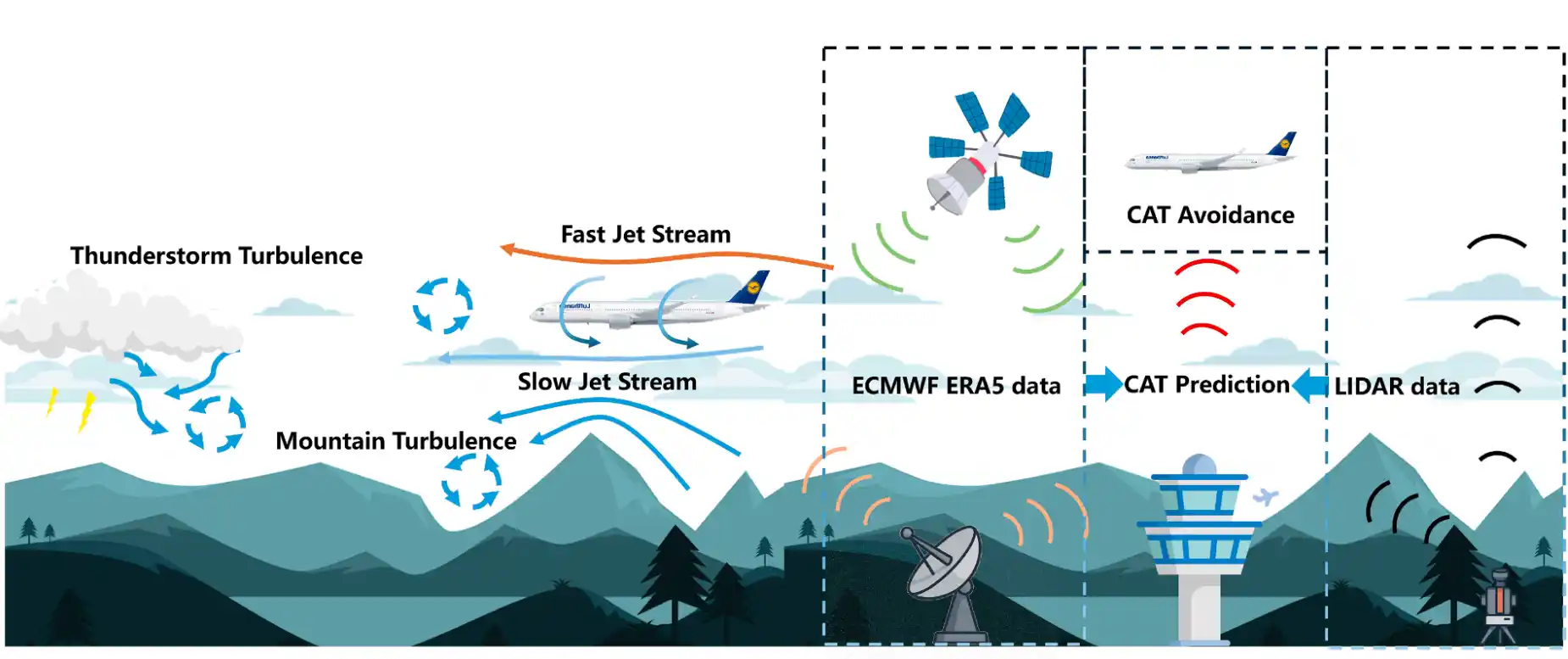
A predict-then-optimise framework was developed to integrate clear-air turbulence (CAT) forecasting with operational trajectory optimisation. A transfer learning-based CAT prediction model, CAT-TLNet, was trained using ERA5 and LiDAR data and validated against PIREP-derived turbulence observations to improve prediction accuracy and generalisation in data-sparse airspaces. Based on the predicted CAT distribution, full- and partial-avoidance routing strategies were formulated to generate safer and more operationally efficient flight trajectories.
Main contributions of Research 1:
1) The framework integrates multimodal atmospheric data regarding CAT potentials
2) The CAT-TL model employs transfer learning to capture multi-scale CAT.
3) The CAT-to-EDR mapping defines standard thresholds and applies data-driven validation.
4) The turbulence driven model incorporates two kinds of CAT avoidance strategies.
5) Numerical tests demonstrate high performance of the proposed predict-then-optimise framework.
Research 2: Priority-driven Reinforcement Learning for Multi-aircraft Trajectory Optimisation under Dynamic Weather Hazards.
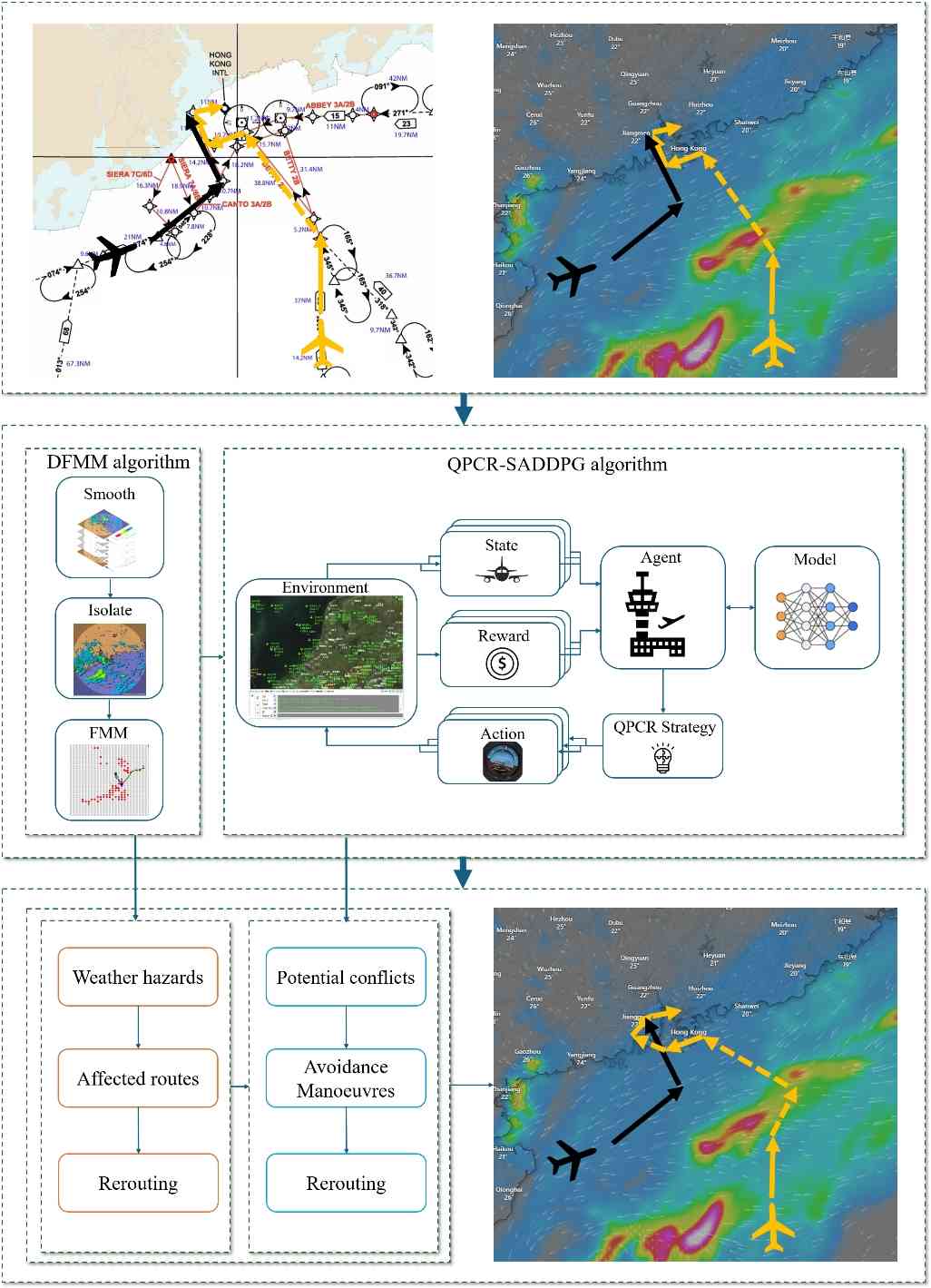
An integrated reinforcement learning framework was developed for 3D multi-aircraft trajectory optimisation under dynamic weather hazards in terminal manoeuvring areas. A Dynamic Fast Marching Method (DFMM) was introduced for weather-aware trajectory rerouting, while a Quickest Priority-based Conflict Resolution (QPCR) strategy was developed to optimise aircraft sequencing and available control actions. The framework combines DDPG with a self-attention mechanism and was validated using real-world approach procedures at Hong Kong International Airport, demonstrating effective conflict resolution, weather avoidance, and trajectory optimisation under varying traffic and weather conditions.
Main contributions of Research 2:
1) An integrated model based on the DDPG framework incorporates the self-attention mechanism.
2) The framework utilises the QPCR strategy to fasten conflict resolution.
3) The DFMM algorithm reroutes influenced flight procedures under dynamic weather hazards.
4) The conflict detection model employs a flexible separation standard.
5) Numerical tests demonstrate high efficiency and effectiveness given different operation conditions.
Key Publications
Journal Paper
[1] Zhu, C., Zhang, C., Ng, K. K. H., Chan, P. W., & Delahaye, D. (2026). Enhancing air traffic safety through clear-air turbulence prediction and trajectory optimisation. Transportation Research Part C: Emerging Technologies, 190, 105791. https://doi.org/10.1016/j.trc.2026.105791.
[2] Zhu, C., Ng, K. K. H., Chan, P. W., Liu, Y., & Leung, C. Y. Y. (2026). Priority-driven reinforcement learning for multi-aircraft trajectory optimisation under dynamic weather hazards. Transportation Research Part E: Logistics and Transportation Review, 205, 104496. https://doi.org/10.1016/j.tre.2025.104496.
[3] Zhu, C., Zhang, C., Ng, K. K. H., & Delahaye, D. From Turbulence Forecasts to Trajectory Decisions: Bayesian Predict-then-Optimise under Clear-Air Turbulence Uncertainty. Transportation Research Part B: Methodological. (Manuscript in Preparation)
Conference Paper
[1] Zhu, C., Ng, K. K. H.*, & Delahaye, D. (2026, Nov.). Operational Trajectory Optimisation for Flights Under Predicted Clear-Air Turbulence. IWAC2026, Japan.
[2] Zhu, C., Ban, W., & Ng, K. K. H. (2025). Enhancing clear-air turbulence forecasts: A WTCNN-LSTM framework utilising energy dissipation rate. In AIAA AVIATION FORUM AND ASCEND 2025 (Paper No. 2025-3715). American Institute of Aeronautics and Astronautics. https://doi.org/10.2514/6.2025-3715.