Reducing Greenhouse Gas Emissions through Rubberized Asphalt Pavement Technologies
Seminar
-
Date
02 Jun 2026
-
Organiser
CEE / RNUS
-
Time
09:00 - 10:00
-
Venue
Z414, 4/F, Block Z, HKPolyU
Speaker
Prof. Zhanping You
Enquiry
Mr Xinnan Xu [CEE] xinnan.xu@connect.polyu.hk
Summary
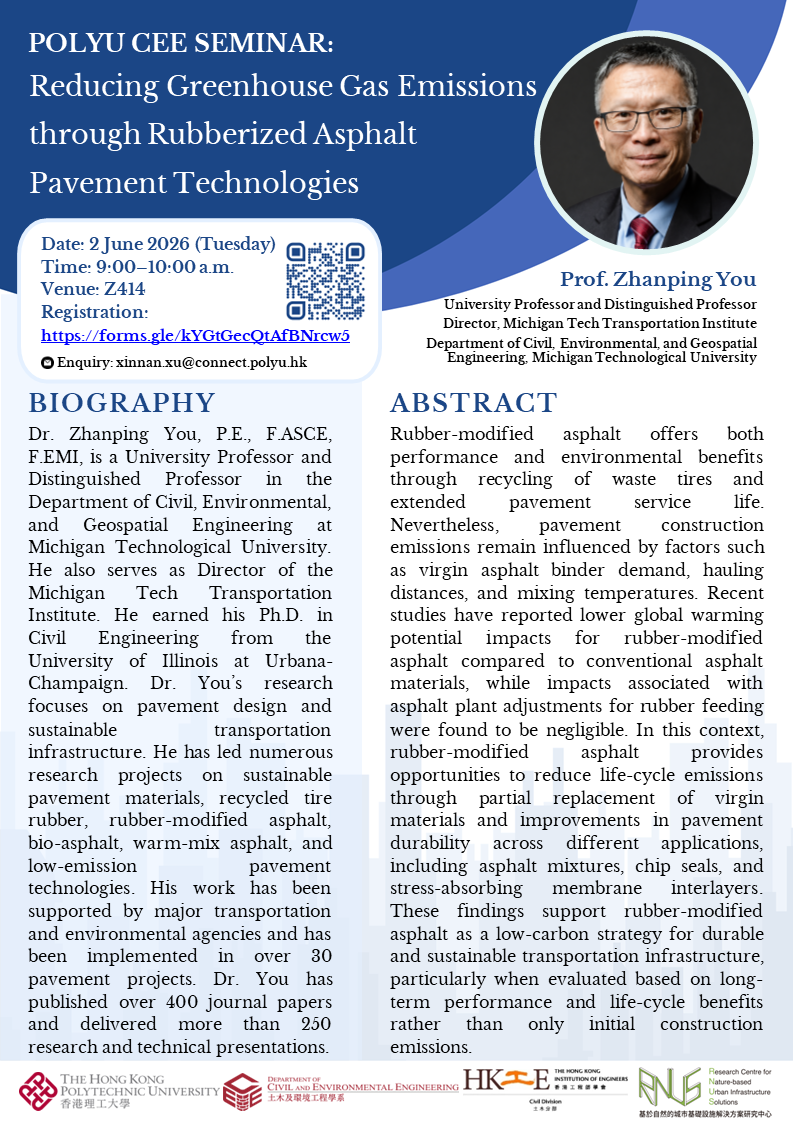
Rubber-modified asphalt offers both performance and environmental benefits through recycling of waste tires and extended pavement service life. Nevertheless, pavement construction emissions remain influenced by factors such as virgin asphalt binder demand, hauling distances, and mixing temperatures. Recent studies have reported lower global warming potential impacts for rubber-modified asphalt compared to conventional asphalt materials, while impacts associated with asphalt plant adjustments for rubber feeding were found to be negligible. In this context, rubber-modified asphalt provides opportunities to reduce life-cycle emissions through partial replacement of virgin materials and improvements in pavement durability across different applications, including asphalt mixtures, chip seals, and stress-absorbing membrane interlayers. These findings support rubber-modified asphalt as a low-carbon strategy for durable and sustainable transportation infrastructure, particularly when evaluated based on long-term performance and life-cycle benefits rather than only initial construction emissions.